New Year, Old Ideas, Fresh Vision

Annual routines break the daily routine and with any luck our imagination and ideas stir.  There is something about the anticipation and the efforts of the holiday season that bends its way to the “let down” and then the clean slate of the New Year. What’s old can be new again.  This is my cheesy way of saying we are going to repeat some favorite exercises right off the bat.

Not to act as philosopher, but to steal from one of the best, here are two quotes from Joseph Campbell to twist into art-making and ponder how they may apply:

“When we quit thinking primarily about ourselves and our own self-preservation, we undergo a truly heroic transformation of consciousness.

“We must let go of the life we have planned, so as to accept the one that is waiting for us.

Be ready to have a “transformation” of, at the least, expectation, and be ready to accept the creation that is “waiting for us”.

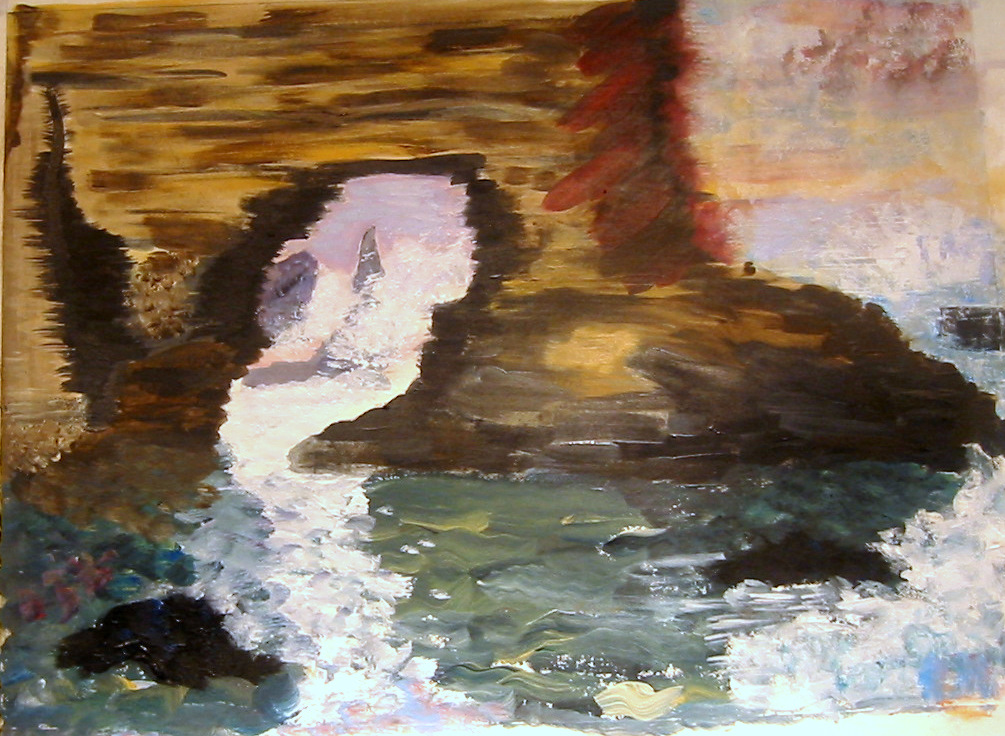
Our exercise will involve the unexpected and the unplanned. But you will need a SUBJECT. (Make it something that you feel a connection to, but avoid anything that is simply figure and ground–it is too hard to “transform”.) You may use either a fresh surface or an “underpainting”. If you are working on something that you want to further develop and explore, save it for another time.

If you don’t have a subject, come early enough to find or build one. Reflect on the thoughts discussed when we talked about choosing a subject. (That blog post can be found on the column to the right.)

Bring everything except a sense of control of what you are going to paint.


Posted in Uncategorized | 2 Comments

2010 in review (blog stats from wordpress)

The stats helper monkeys at WordPress.com mulled over how this blog did in 2010, and here’s a high level summary of its overall blog health:

Healthy blog!

The Blog-Health-o-Meter™ reads This blog is on fire!.

Crunchy numbers

Featured image

A Boeing 747-400 passenger jet can hold 416 passengers. This blog was viewed about 2,500 times in 2010. That’s about 6 full 747s.


In 2010, there were 26 new posts, growing the total archive of this blog to 27 posts. There were 150 pictures uploaded, taking up a total of 69mb. That’s about 3 pictures per week.

The busiest day of the year was July 13th with 129 views. The most popular post that day was Works in Progress for “Under the Influence”.

Where did they come from?

The top referring sites in 2010 were mail.yahoo.com, mail.live.com, mail.aol.com, sz0170.ev.mail.comcast.net, and webmail.aol.com.

Some visitors came searching, mostly for arthouse23 wordpress, diebenkorn, richard diebenkorn, howard hodgkin, and lucien freud.

Attractions in 2010

These are the posts and pages that got the most views in 2010.

1

Works in Progress for “Under the Influence” July 2010
5 comments

2

New Pics Posted July 2010

3

Week of 7/25/10 & Figure studies in progress July 2010
5 comments

4

Blooms of Light 9/15/2010 September 2010

5

Under the influence / Work Study July 2010
4 comments

Posted in Uncategorized | Leave a comment

The Party’s Over

Don’t you just love when after a great night of over-indulging in laughter, singing, dancing and imbibing you get some good rest and then you begin eat right, drink lots of water and exercise, feeling refreshed?  Consider this week “good rest”.  This is a week for working on those pesky sketchbooks or anything else that may be nagging at you. If  all the “leftovers” have been cleared,  be prepared to play with newly-gifted art supplies, things that spark your curiosity or just working on very small pieces that may not be as intimidating as a big, clean sheet of paper. (Time to use those odd scraps that are cut from a full sheet, or the small watercolor tablet given at last year’s Christmas party, or, if neither of those are available to you, I have some small sheets.)
 
Stretch, breathe, get ready for more exercise–just after we rest a little… 
Remember–no class on Saturday, New Years Day.
Posted in Uncategorized | Leave a comment

PartyTime!

Holiday cheer is in order! The festive, holiday punch ice ring is freezing as I type and the walls in the studio are ready for your group efforts.

Come with a few paints, especially neutrals–black, white raw umber and buff, paynes gray, etc.  Throw in a yellow or two and a couple of blues and reds.Also bring a few brushes–not your finer hair brushes, but some bristle or synthetic brushes.  You will want a stick of charcoal or a crayon–something to   draw large scale and a pallette and perhaps a pallette knife.  MARK THINGS AS YOURS so they are not lost.

No food is necessary unless you are opposed to eating pulled pork, coleslaw and homemade hot bean dip seasoned with summer chilis.

In the meantime here are a couple of additional presents–a wonderful poem about Goya by the delightful Billy Collins and a fun “drip painting” site to play with–toys for every girl and boy….

Candle Hat

In most self-portraits it is the face that dominates:
Cezanne is a pair of eyes swimming in brushstrokes,
Van Gogh stares out of a halo of swirling darkness,
Rembrant looks relieved as if he were taking a breather
from painting The Blinding of Sampson.

But in this one Goya stands well back from the mirror
and is seen posed in the clutter of his studio
addressing a canvas tilted back on a tall easel.

He appears to be smiling out at us as if he knew
we would be amused by the extraordinary hat on his head
which is fitted around the brim with candle holders,
a device that allowed him to work into the night.

You can only wonder what it would be like
to be wearing such a chandelier on your head
as if you were a walking dining room or concert hall.

But once you see this hat there is no need to read
any biography of Goya or to memorize his dates.

To understand Goya you only have to imagine him
lighting the candles one by one, then placing
the hat on his head, ready for a night of work.

Imagine him surprising his wife with his new invention,
the laughing like a birthday cake when she saw the glow.

Imagine him flickering through the rooms of his house
with all the shadows flying across the walls.

Imagine a lost traveler knocking on his door
one dark night in the hill country of Spain.
“Come in, ” he would say, “I was just painting myself,”
as he stood in the doorway holding up the wand of a brush,
illuminated in the blaze of his famous candle hat.

Drip painting without the mess:  http://www.jacksonpollock.org
Posted in Uncategorized | Leave a comment

“Magic of the Season”

Ok, I’m reaching with the title.  All clever connections are buried under so much Holiday cheer, lists, wrapping paper and twinkling lights, its the best I can do–sigh.

Polling of both classes resulted in an overwhleming vote to continue working on pieces in progress.  So that’s the plan. And in order to keep all things “themed” as I am want to do, I will share a quote from one of my greatest “teachers”, the great Abstract Expressionist,  Hans Hofmann: “Art is magic. So say the surrealists. But how is it magic? In its metaphysical development? Or does some final transformation culminate in a magic reality? In truth, the latter is impossible without the former. If creation is not magic, the outcome cannot be magic.”—Search for the Real and Other Essays (1948) by Hans Hofmann, edited by Sara T. Weeks and Bartlett H. Hayes, Jr. Addison Gallery of American Art; (using M.I.T. Press edition (1967); (Partial online PDF)

This additional quote from Heir Hofmann is a little extra ‘gift’:  “I do not want to avoid immersing myself in trouble — to be a mess — to struggle out of it. I want to invent, to discover, to imagine, to speculate, to improvise — to seize the hazardous in order to be inspired. I want to experience the manifestation of the absolute — the manifestation of the unexpected in an extreme and unique relation. I know that only by following my creative instincts in an act of creative destruction will I be able to find it.”  Statement of April 1950, as quoted in Hans Hofmann’ (1998) by Helmut Friedel and Tina Dickey

So while working on pieces in progress let’s keep the magic by being willing to make “a mess”.  I will demonstrate some techniques that will be new to some but familiar to others.  Those who wish to watch can gather round and those who wish to keep working may do that.  

If you have a piece that is fresh and new and you want to keep it that way have two pieces going at once, one with which you can improvise and “seize the hazardous”. The other controlled piece  might be the repository for a spark of inspiration that results from allowing your work “to be a mess —and (sic) to struggle out of it”.

Posted in Uncategorized | Leave a comment

Wax on, Wax off

As some of you know I’ve become a sports fan this year because of Ducks football. Not just because the Ducks seemed destined to go to the National Championship this season, but because of the way they approached the endeavor.  Despite Coach Kelly’s confidence that his team could be champions, each player’s participation in  the sport was not about the game but about the preparation. It was about each day.  It wasn’t about the big outcome, it was about being present and committed each step of the way, staying focused on the task at hand and not the potential glory days– still keeping their passion alive for each pass, each run, each block, kick and tackle.

On the field they were slow to tire and they didn’t doubt even when they were behind. They knew their job and did it to the best of their ability with a quiet confidence. They did not expect perfection, therefore they were willing to take risks.  When the risks worked out the pay-off may have been big.  When they didn’t work out there was no time for self-flagellation. They just got back to doing their job.  “Wax on, wax off”–(Karate Kid.)

And they still had fun.  They did not lose sight of the fact that it is a game, a past time that teaches as it gives them pleasure.  Sure there are a few players who might go pro, but the other eighty players do it for the joy of the game. (Leave out all thoughts of college-aged hormones.)

Coach Kelly teaches a Zen-like philosophy with his football that is clear to me when I watch his team and listen to what he says.  It mirrors the way I  think about painting.  Concern with the process not the outcome, doing what it takes to keep focus and passion alive, being willing to take risks knowing that failure is just another lesson learned and having fun while exploring limits of our capabilities.  Good philosophy for football and life—and essential for creativity.

This week we are still focusing on choosing a subject.  If you liked what you chose last week and want to explore it further–great! See what new ways you can look at it, what new ideas it might spark.  But if your subject proved difficult or uninspiring, try to figure out why. Then choose another asking these questions  Does your it offer you “good bones” giving you a workable structure? Does it allow you to use it make an original statement?  Does it give you an emotional charge when you look at it? Is it something you can stay connected to? Does it feed you?  It will be fun to see the new ideas.

Those pesky sketchbooks:   Tuesday looks like a good sketchbook day.  I will be at the warmed studio doodling away by 4:00–anyone is welcome to join.  If you want to bring food, fine, if not fine–we have lots of apples and cheese and if we stay long and get too hungry we can always order a pizza. I turn into a pumpkin early, so will want to leave by 8:00.

Posted in Uncategorized | 2 Comments

Moving On

“Anything you do, let it come from you–then it will be new.   

Give us more to see.”   

From the song “Move On”-Sunday in the Park with George by Stephen Sondheim.

In the play painter George Seurat struggles with “…..how to get through to something new. Something of my own!”  His paramour counsels: “I chose, and my world was shaken—so what?  The choice may have been mistaken but choosing was not. You have to move on.”

We are moving on after the culmination of another year’s work. And a first step in the process is choosing a subject.

What to paint is a question I hear often. It is a question I clearly remember asking. I’m not sure when the uncertainty dissolved for me or if it’s gone for good. But I have developed an awareness of how I choose.

There is always a moment when considering my next subject where I pay attention to my heartbeat–a moment of visual excitement.  Something that causes a small gasp or an overall emotion is a contender.

Whether that emotion comes from the object or scene or its meaning, or whether it comes from pure color, textures, or contrast, etc. doesn’t matter.  Once a subject captures my attention, I want to explore it further.

The next step is shifting the brain to quickly assess what the subject offers in terms of composition. If a photo of a sunset contains fabulous light and color and makes me melt, but has only a horizon line in terms of composition, it is going to be very difficult to translate that into something original. I need something more to hook into, something to arrange on the page.  However,  if I start with complexity of form that ends up to be little more than a horizon line dividing two color fields, that’s different. All the process is there, pulsating underneath the two areas forming the horizon. It creates an authentic richness—evidence of the experience, the searching, the attempts to understand.  That is the part that comes from you.

Our task this week is to bring a subject to paint–something that resonates, something that you connect to, something that will propel an authentic expression that comes from you.  Think about how  you usually find a subject. What do you look for in its character? Do you  prefer a photo or real life? How are they different?  (Photos are easier because some of the translation from 3-d to 2-d has been done, but they can lack an element of “life” in real objects.)  If you choose a photo image try working from a black and white copy of it. This will eliminate the challenge of color.  It will also help you to see the “bones” of a piece and allow for a freer interpretation. (When beginning the piece turn your photo upside down in order to sketch the structure.) If you choose to interpret another artist keep in mind it is most effective to translate and transform work that is different from your own.  Remember, as Martha Graham says: “There is only one of you in all of time…keep the channel open.” So connect to a subject and come prepared to paint.

Excerpts from a heavily edited article (by me, for brevity sake) by UK art critic, Laura Cumming.  To read the full article click here:  http://www.guardian.co.uk/artanddesign/2009/sep/20/guide-to-painting-subject

“What to paint? Writers are always advised to write about what they know, but what should artists depict? If they all only painted what was in front of them, or what was inside them, art history would be short of all sorts of masterpieces, from The Sistine Chapel to The Last Supper…..

Finding subject matter can be a lifelong struggle. Mondrian spent decades painting windmills and rivers before he found form with geometric abstraction. The American painter Philip Guston tried socialist murals, allegories of children’s games, and years of abstract impressionism before he eventually hit upon the queer and tragic-comic near-cartoons of contemporary life that sealed his fame for the future. He was, he said, embarrassed to be fiddling about with ethereal tones when news of Vietnam was on the radio.

In the past, academic tradition conveniently chose the subjects for you. You could do portraits, religious or historical scenes, genre paintings, landscapes or still lifes

For Rembrandt and Hals, the rise of the middle classes in the new Dutch republic created both an immediate subject and a market.

Vermeer closes the door on the outside world with his women lost in thought, in letters, in music, sessions of still, silent thought. But his interiors show exactly how the content of a painting can be so much more than its subject.

Every seed in a loaf, every brass tack, every tuft of a rug has its moment, but Vermeer’s true theme is the passage of light. The artist paints light as the source of revelation.

Light is the subject for Turner and Constable, with their seas and skies, and later for the impressionists, trying to catch its fleeting effects on the open-air world. Monet paints the grainstacks over and again, from dawn to dusk.

Dürer once risked six days on a freezing boat to paint a whale washed up on a beach. But artists such as Chardin and Morandi barely left the house, finding everything they needed at home.

Willem de Kooning once said that flesh was the reason oil painting was invented, and for some painters the medium determines the subject. Cézanne’s apples take on both the luminosity and the weight of the paint, more glowing and monumental than reality. Frank Auerbach’s portraits, great hulks of clotted pigment densely painted and overpainted, evidence of each successive sitting, each previous attempt to get across the face and character of the sitter, represent both memory and mutability.

And Lucian Freud’s naked figures, of course, are bodied forth in paint to such a degree as to make sense of his remark that, “As far as I am concerned, the paint is the person.”

All painters contend, to some degree, with those who came before them, and perhaps some subjects are definitively taken: Van Gogh’s sunflowers, Degas’s ballet dancers, Cézanne’s Mont St Victoire.  

If you don’t know where to start, take Leonardo’s advice and look at the stains on your walls: there you will find endless new forms to jump-start a painting.”

And Robert Genn says: (I’ve emphasized the words to keep.) “The creative life requires a steady progression of experimentation and discovery. While acquired wisdom is useful, your knowledge must work in tandem with the daily exercise of your curiosity….

Personal refinement of vision makes creativity worthwhile. What you do may not be unique in the greater world of art, but it’s the sweet ignorance of outcome that drives you on.”

 Spend some time choosing a subject “….let it come from you–then it will be new.”

Posted in Uncategorized | 2 Comments

Show Pics and More

The reviews are in and from all reports from our guests the caliber of the art in this year’s show was head and shoulders above the last.  Once again –congratulations!

Here is a link to a You Tube slide show of the work on the first floor: http://www.youtube.com/watch?v=xDXYs0umWCk

(Apologies for not getting to the 2nd floor for pics. When other photos come in we can add them to the blog.)

As reported from the last email this week we are going to tackle those sketchbooks for which so many of us signed up to do. If you don’t have a sketchbook, assemble some small sheets of paper to use in the same way.

The question–What is a sketchbook?  What is it today? What might it be on another day? Is it a scrapbook?  Is it a journal? Is it a record or a map? Is it a way to develop ideas?  Or is it a way to explore one specific idea? How do you best represent a theme in multiple pages? Or multiple themes in one book?

However you answer these questions, it is definitely for exercise and experiment. And it can be as random or as designed as you choose.

Here is a link to a crazy-complete website about sketch books that is very inspiring: http://www.squidoo.com/sketch-book If you only have time to look at one thing scroll down about a third of the way to Hokusai animated sketchbook – a must see.

Think about how do you take quick sketches and develop them into artwork.

Posted in Uncategorized | Leave a comment

The Imagined Vision Takes Physical Form 11.01.10

Exhibiting art can be considered a completion of the art-learning process. It expands the context in which our art exists. We see it from a larger perspective. We see it at a distance and up close and over an extended period of time.  We see it in relation to our other work and to the work of others.  It raises ideas. Aesthetics and expression are explored more in depth than in our talk-backs. It is the opportunity to be “hit” by the impact of a work of art as it hangs, dressed for show, on the wall. It is a chance to hear how other people perceive art–our art.

Aye, there’s the rub. In inviting feedback, there is an opportunity to recognize the value of your own art through the appreciation shown by an audience. But the possibility exists that the audience does not show the appreciation we all hope for. And that may or may not reflect the actual merit of the work.  It is a very hard thing to know.  Despite the larger context and distant perspective, we remain too close and the subjectivity of the viewers cannot be anticipated.  

If we truly have a unique vision, a unique point of view and we express it as authentically as we know how, it is all we can do. But it may not be understood by others or even by you—yet. Van Gogh’s greatest legacy is being the supreme example of an artist whose expression is so genuine, so universal it continues to speak to enthusiastic followers long after his short life and “career” as an artist ended. Yet while he painted his champions were few. We may never know ultimate value of what we do.  

The lesson remains in the doing and in the looking, observing all in order to inform.  Take this opportunity to be empowered and motivated by your own paintings. You all dig deep at this time and the work unfolds. It is very exciting to watch.

I am so looking forward to this exhibition.

Posted in Uncategorized | 1 Comment

It isn’t a Shot of Whiskey for Breakfast! 10/27/10

Entry From Wikipedia-  Art exhibitions are traditionally the space in which art objects (in the most general sense) meet an audience….. In American English, they may be called “exhibit”, “exposition” (the French word) or ‘show’.”

Exposition— from the word expose ~verb~ to reveal the true nature of.

Reveal—the root of revelation.

Revelation~noun~Something disclosed, especially something not previously known or realized:  Informal~ eye opener.

From verb to noun, what is the most valuable thing the activity of mounting an exhibition provide? Clue: It isn’t attention , or recogntion, or the food and drink, or replenishing the coffers .

Discuss.

Posted in Uncategorized | 2 Comments