L’Chaim—to Life!

From Wikipedia—“One definition of fine art is ‘a visual art considered to have been created primarily for aesthetic and intellectual purposes and judged for its beauty and meaningfulness—specifically in, painting, sculpture, drawing, watercolor, graphics, and architecture.’” (In that sense, there are conceptual differences between the fine arts and the applied arts, which include pottery, weaving, mosaics, etc.)

The figure as subject is an enduring theme in the study of fine art. We can list a number of reasons why, but the most common reason sited has to do with the challenge of “seeing”. Great acuity is required when studying the human body in order to understand form and proportion as light and shadow bends over the figure. The elegance of line can be easily accessed. And the model can be readily changed. How the body, moves, bends and flows provides endless compositional as well as drawing challenges. You are engaging in—“aesthetic and intellectual purposes and judged for its beauty and meaningfulness” in its highest practice.

The biggest difference between life drawing/painting and any other subject is the energy that the model brings with him or her. The room changes when the model enters. It is reported that the human body contains enough energy to light a 100 watt light bulb. Think of how turning on a light can alter the feeling of any space.

With figure work you have before you a living, breathing being that can bend, twist, extend, turn, balance, fold, etc. etc., and with enough energy to light up the room. It’s an interactive experience! What a subject!

The challenge for the artist is to finds ways to connect and  to see the figure in a new way, to find an approach that will encourage further engagement and to limit frustration. Drawing the figure is hard. And it’s easy to get trapped into attempting to render something expected, but that lacks life.

So this week as you observe the scenes around you, imagine how an unexpected use of the figure in your work might aid your vision and improve your skill set. Notice what happens when you “crop” your view, when you see multiple figures next to each other or stack in front and behind, or when you create a new and different context. It is unlikely you’re seeing figures nude, but allow some imagination in your observation. What about color or strong contrast. Can texture enter into your composition? Can it define the form? What if the pose is repeated multiple times? Just ponder.

I will have some suggestions of how to incorporate our model into the whole, but feel free to come up with your own ideas and share. We will do quick gestures and some longer poses. Collage and underpaintings can/will be employed. Think about a series of smaller pieces that can build one image. And then think about the reverse—a larger image that can be deconstructed and put back together. After entertaining these ideas be ready to react in the moment, feel the presence in front of you when you look at the model and connect to it. Don’t be so hot to use your tools that you don’t see.  Look.  Feel. Bond. Be ready to put “life” into life drawing.
Posted in Uncategorized | Leave a comment

To Be or Not To Be– or May the Force Be with You

There is a T.V. special coming up on OPB (Mon. 10/19) about the Oregon Shakespeare Festival which I (and several others of our group) was lucky enough to attend recently. How incredible to have this resource in our own back yard. This kind of theater– honest, raw, poetic, funny and beautiful– illuminates the power of art. This theater experience is another example of the importance of conncetion.

There was a monologue from Long Day’s Journey Into Night which I’ve heard many times before, but yet, I’ve never heard before. This performance by Danforth Comins cracked open my heart. Blood and fresh oxygen intermingled. I was touched to the point of tears. What a joy to be able to feel that way! Art can do that! It is no wonder this play, along with 3 others, merited Eugene O’Neill a Pulitzer prize (and a Nobel Prize for Literature). It was a late play and highly auto-biographical—catharsis out loud. (http://www.actorama.com/ms/491/Eugene-O-Neill/Long-Day’s-Journey-into-Night)

Actors talk about delivering lines like these. They are hard to say in a way that resonates. They are so intimate and personal, naked and truthful that it is very easy to be self-conscious or simply not understand the depth of the honesty that the author was willing to reveal. I’ve listened to this monologue online recited by several different actors after seeing the OSF production last week and I know why I remembered the power of the plot but not the poetry in the play. In the recordings the lines were not rooted in the heart and soul of the speaker as they were in the writer.

One of the things the actors mention when discussing their craft is the importance of their collaborators onstage. They talk about trusting. They talk about looking in their partner’s eyes and feeling “the net”. They talk about the freedom and the security to recreate performance without conscious thought. They talk about “being in the moment” despite having recited those words hundreds of times. It’s the ability to be that “present” and connected that communicates meaning and character to the listeners.

These principles are the same in any creative act that reverberates with an audience. But in painting there is usually no collaborator, except perhaps your subject.

Choosing a subject is tricky business. Do you explore something that is a simple, or perhaps a complex, curiosity? Or do you look to express deep emotion? Is it about imagination or invention? Or is it about re-creating beauty, or sharing some experience? Is there a political statement that feels important, or a “love letter” to a time and place? Whatever it may be, the most important part of the process of painting is the connection you have to your subject, even if it is only in your mind’s eye. And like the actor, trust yourself enough to feel the freedom and the security to create without conscious thought. Let the importance of results fade away in the doing.

So I’m saying care but don’t care. Trust. See. Be willing to let go and look to yourself to find “the net”. In sports they say “Be the ball” or “be in the flow”. In modern culture, it’s the “force”. Ben Obi-Wan Kenobi: “The Force is what gives a Jedi (an artist) his power. It’s an energy field created by all living things. It surrounds us and penetrates us. It binds the galaxy together.”To reach out and touch someone, or, in effect, bind yourself to another, a stranger,through your creative efforts indeed implies there are forces at work.

If you’re not familiar with the Oregon Shakespeare Festival, check out OBP on Monday to see this amazing “force” in our own little section of the universe– and may the force be with you.

For further reading here is a Psychology Today article that also talks about connections (slightly different, but it all hooks up for me.) : https://www.psychologytoday.com/blog/imagine/201003/einstein-creative-thinking-music-and-the-intuitive-art-scientific-imagination

Posted in Uncategorized | Leave a comment

Asking Questions, Making Choices, Making Connections

Ta da! Back and anxious to record thoughts and ideas again. The mind is pulling at many strings that long to be connected. Like a crow that picks up shiny bits and bobs to make a roost, I will try to connect together some glittery threads that have streamed past me in these last months, beginning the blog again just before another group exhibition.

When we make connections we make choices. Our choices define. In creating they almost always have meaning no matter how slight. Reflecting on what your hand chooses and how you approach your work provides glimpses into self-awareness.

If it is to speak in any way, art-making is about meaning. It is born out of countless things, from a desire to call forth the wild for a successful hunt, as in humans’ first attempts at marks on a wall, to Banksy’s latest commentary on our modern culture—Dismaland. (http://www.theguardian.com/artanddesign/jonathanjonesblog/2015/aug/21/in-dismaland-banksy-has-created-something-truly-depressing ) It all says something.

Our experiences feed and affect our message. We may or may not know the impetus for a work and it may or may not be important. But the impetus, despite how buried it may become in the fiber and the pigment, still has the power to touch the viewer through our chosen imagery. When do we ask “why?” or better question: when is asking why useful?

Sculptor Christopher Saucedo, who endured losing his brother in the 9/11 World Trade Center attacks, (and then was left homeless Katrina, then lived through hurricane Sandy), speaks to a transformation in his work: “I’m a sculptor who primarily works with steel and wood and cast metals and big physical materials,” he says. But, according to Nula Eulaby on NPR,: “after being at ground zero, he didn’t want to memorialize the catastrophe with exactly the same material that comprised the World Trade Center’s remains. Instead, he hand-pressed layers of linen, making 10 blue papier-mâché rectangles. It’s recognizably a Sept. 11 blue — the blue of that day’s sky. There appear to be clouds floating on the surface, but a closer look reveals that they’re wispy renditions of the World Trade Center — two towers seemingly made of vapor, floating up and away.”

http://www.npr.org/2015/09/11/439236972/after-sandy-katrina-and-sept-11-this-sculptor-finds-art-in-survival

His pictorial language is thought anew because of his reflection on his experience. And his awareness of his response to such tragedy aided in developing a unique visual poetry.

In my work I rely on a combination of following the subconscious and looking to source material. The two paintings currently in the ReMax show are examples of that. One came from a subject suggested by the theme of the exhibition, the other came from following unknown passage-ways until an image that resonated appeared. Both ways of working are valid. The latter is more frustrating and definitely scarier, but more satisfying to me in the end. (Someone said if you’re not afraid, you’re not creating.)  Both teach me something about myself when I take time to think about the color, shape and line choices, which direction, how much contrast, perspective or no, etc., etc. It all matters.

In the process of curating that show, because of it’s theme, we saw a lot of the same subject matter represented in the same media. Most pieces were similar in size and often the palettes were comparable. Yet the show is extremely varied and exciting. So what is it that makes a difference?

Why does Sally choose to put a veil of stripes over an image and how does it change how it is viewed? Why does Lois build so much texture? Why does Sue like to order things so precisely? What is Nan going for with all of those colors? Clear-cut answers are unimportant, but asking the questions—asking the questions forms connections, expands our thoughts and ideas, teaches us about our emotions and often reveals our own riddles.

When you see art you like, ask yourself why? When you see art you don’t like, ask yourself why not? And when looking at your own work ponder your choices. Let the answers elude if they insist.  Just continue to “notice what you notice” with intention and be willing to let any experience that touches you either re-form or reaffirm your work.

Posted in Uncategorized | Leave a comment

Tortured Artists

The movie Birdman won the academy award for best cinematography. The bulk of the story is visually told as if the viewer is following the character with a Go-Pro.  Sequences of frustration, doubt, fear, desperation, backstage tantrums and on stage brilliance and mediocrity all merged into one long voyeuristic event woven together with the haunting images of main character’s shallow alter ego hovering close by.

His present is comprised of a cramped, cluttered, seedy dressing room; long, badly-lit, dingy hallways; and the stage, where lights shine bright on his art and his vulnerability. His past hangs over him with supernatural powers soaring free, but at the same time alienating him from his humanity.

He’s struggling with a tough choice—ambition or artistry. Can you have both? Can playing a meaningless character that allows flying above the gritty streets of New York but keeping distance from what’s real be success?  Or is risking fortune and reputation in search for authentic self the way to true art?  And who’s to judge? Does someone need to be watching? Is the journey enough?  What are the consequences of failed attempts?  Is there relevance in just the doing?

It’s this internal battle that, for me, became revelatory in those camera shots as protagonist, Riggan, rushed down the dark hallways accompanied by nervous, jazz drumbeats. I couldn’t help but think of Through the Looking Glass, when the Red Queen grabs Alice’s hand and they run faster than Alice has ever run—“Well, in our country,” said Alice, still panting a little, “you’d generally get to somewhere else—if you run very fast for a long time, as we’ve been doing.”

“A slow sort of country!” said the Queen. “Now, here, you see, it takes all the running you can do, to keep in the same place. If you want to get somewhere else, you must run at least twice as fast as that!”

As we study artists like Turner and Whistler and Van Gogh and Gaugin and even Rembrandt, take note of what it took for them to gain and keep acceptance, to earn respect and a living and note those who did not succeed in their lifetime or fell into ruin after initial success.

The pursuit of art for some is a pleasant pastime.  For some it is a way to be social.  Others find solace or excitement in discovery through the paint. For others it is a drive that is relentless. It can leave you breathless and confused and to get somewhere else you must “run twice as fast” (sometimes in your underwear) and have no idea where you are going or how you will end up. But wherever you run to, you turn around and there you are!

It can be all of those things to the same person at different times, and even on the same day.  Any wonder the stereotype of an artist is often “tortured”?

The movie is about the artist’s ego.  You can’t run from it.  You must have one in order to “say something”.  Too much and you are rendered insipid and impotent. As with everything, it’s balance–long, dark, smarmy  hallways and mystical, aerial flights of fancy.

Onward to the light of Monet and the Impressionists!

Posted in Uncategorized | Leave a comment

Necessity is the Mother of Invention

Hearing last week’s Radio Lab regarding the paralyzing effects of too many choices reminded me of how often unexpected success comes to people who are new to painting who have few materials and don’t know how to use them.

Barry Schwartz, the author of the Paradox of Choice and long-term professor of Social Theory and Social Action at Swarthmore discussed the crisis of confidence his graduating seniors feel as the world opens up for them. Anxiety arises with the thought that the many possible doors that they don’t choose upon graduation, may close.  “People don’t know what to do.  They don’t know how to choose.  Students who have every possibility available to them crowd student counseling center.” They are plagued with the possibility that they might not choose as well as they could. They feel regret and that begets stress which hampers performance.

Neurologist Oliver Saks, author of ten books, Awakenings among them, describes his daily life and the extreme limits he puts on his choices in order for him to spend his energy on the things he cares about most. He essentially eats the same thing every day— a large bowl of oatmeal for breakfast, a noon meal of herrings and black bread, tabouli and sardines for dinner. Snacks consist of an orange and an apple and orange Jello.  He puts a single dollar in his pocket as he walks past the neighborhood chocolate shop where he buys one single dollar’s worth of broken, 72% chocolate.  He said more than one dollar in his pocket would cause him to eat more chocolate than is good for him, so he limits his ability to buy it. This does not bore him.  He says he enjoys each meal with “equal relish”.  It allows him to keep his internal life active, growing and evolving.

Malcom Gladwell, the author of The Tipping Point discussed how people’s limited capacity for handling options can negatively affect performance when given too much to think about.  He quotes a study that shows how people make bad choices once under the stress of trying to juggle too many options. It says the human brain best handles 7 digits, plus or minus 2. When study participants, who were asked to remember a series of numbers, were interrupted with a choice of snack consisting of either chocolate cake or fruit salad while walking from one room to the next, those who had to remember only 2 numbers almost always chose the fruit salad.  Those who felt stressed by having to remember 7+ digits almost always chose the chocolate cake. What happens to our decision making when we have more choice? The emotional brain wants the cake.

When do we choose, how do we choose?  Do we limit?  What’s the right amount of choice?

I realized that my foot injury limited my choice of actions each day.  And, contrary to what might seem like hardship, those 5+ months of boot-wearing were so much less stressful than when my choices had a wider scope.  Despite the discomfort, I found myself happier, I slept better, I ate better and I was more productive in the ways I value the most.

Translate to our weekly endeavor—“Necessity is the mother of invention.”  Or perhaps–few choices make for more creativity.  So in the spirit of fun and ease in the New Year, this week I will provide you with a limited amount of choices for subject and color.  Have white and black paint and a cool neutral like Payne’s Grey and a warm neutral like ochre or sienna, and of course a substrate and tools.  But other than that, your choices will be how to deal with the limited amount of “input” you are given in terms of paint and subject. The challenge will be to “make do” with what is in the bag and if you don’t like the results, it’s not your fault.

Posted in Uncategorized | Leave a comment

Home for the Holidays

I love that the word holiday comes from “holy day”.

Holyexalted or worthy of complete devotion as one perfect in goodness and righteousness.

That’s how I view time spent for the holidays. Time in itself can be holy in this fast-paced world, but especially when used to reflect and connect with people we love or just with people with whom we share DNA. Time spent with family, chosen or biological, whether we like them or not, whether we get sick of them or not, tells us about ourselves. Whether we see ourselves in them as shared formative years have shaped us together, or whether we just observe how we react to past patterns, energies and traditions. It is an opportunity for redemption when old wounds uncap. It is a chance to practice being “perfect in goodness” and forgiveness as we experience any perceived wrongs. We hold our tongue and make peace and if lucky, learn from that. But mostly, we are reminded from where we’ve come and what is important. That kind of time is holy– a “holiday”.

We had a pretty wonderful holiday—blood relatives stayed 1,000 miles away.  We did reach out and there were insights to be discovered in what was said and what wasn’t–more chances to grow. We celebrated two and three special events with the same dear people with we’ve known for over 40 years. The time spent with my “chosen family” was gratifying and affirming.  And the time spent with our daughter and her fiancé’s family gave us a chance to re-hash parental shortcomings and willful childhood behavior creating an opportunity for understanding. Feelings were warm and gracious as we all speak of their life together.

As usual, for me, whenever there is a chance to note or to take stock of feelings and significances and see the fabric of the past I know it will inform future creative endeavors. I can’t directly correlate just yet but it can’t be helped when work stems from an authentic self. We are as we spend our time. Pondering a subject or struggle with a painting will be influenced by revelations or reassurances that happen over the distinctive time we call the holidays.

A holiday can be a holy day regardless of any religiosity. The time we allow for gathering, for loving and for celebrating allows us to catch a distinct glimpse of “home”, an exalted place that can serve us in the work to come.

Posted in Uncategorized | Leave a comment

Dora the Explorer

This week my studio-mate Angelina and I led a painting workshop for Portland’s homeless street kids.  We didn’t know what to expect but we were aware that this at-risk young adult population has bigger things on their mind than the color wheel or negative space or perspective.  Knowing that the night brings cold, wet and potential danger their daytime activities are instead colored by thoughts of survival and broken dreams. We were also aware that many of the youth would be high.  On this Tuesday it was almost everyone.

I was struck by their politeness.  I’ve taught this age group before– the highest socio-economic population in the state– and none of those kids were as considerate and respectful and polite as these young people. I wondered if they had to gently shepherd other’s feelings just to get by.  I did not see anger or rudeness.

The p:ear arts mentor program provides shelter and food from 8:30 AM until 2:00 in the afternoon.  They also have a room with a few instruments where music can be made freely and there are many art projects in progress and a plethora of materials available for use.  A gallery borders the activity room where professional artwork is in view next to the youth work. They can go and sit in quiet just to look. The staff spends most of their time in the office staring at a computer trying to keep funding and scheduling, etc. rolling. All except for Will, who was recently hired to coordinate the arts program.  He was inspired and excited by our visit and granted our every wish. Volunteers manned the kitchen shoveling out food like they were keeping the engines of the Titanic burning. Hot, homemade apple crisp was one of our rewards.

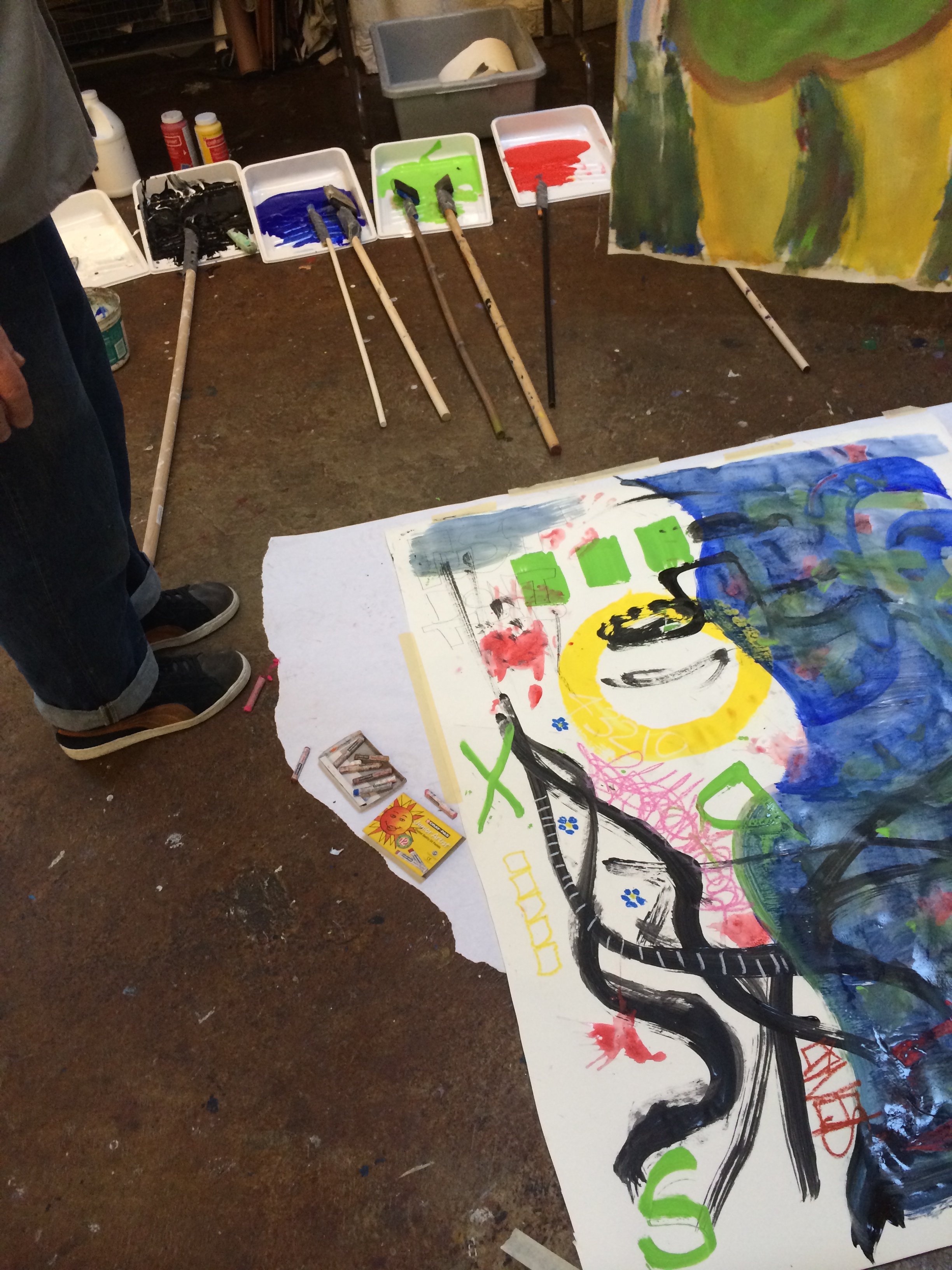
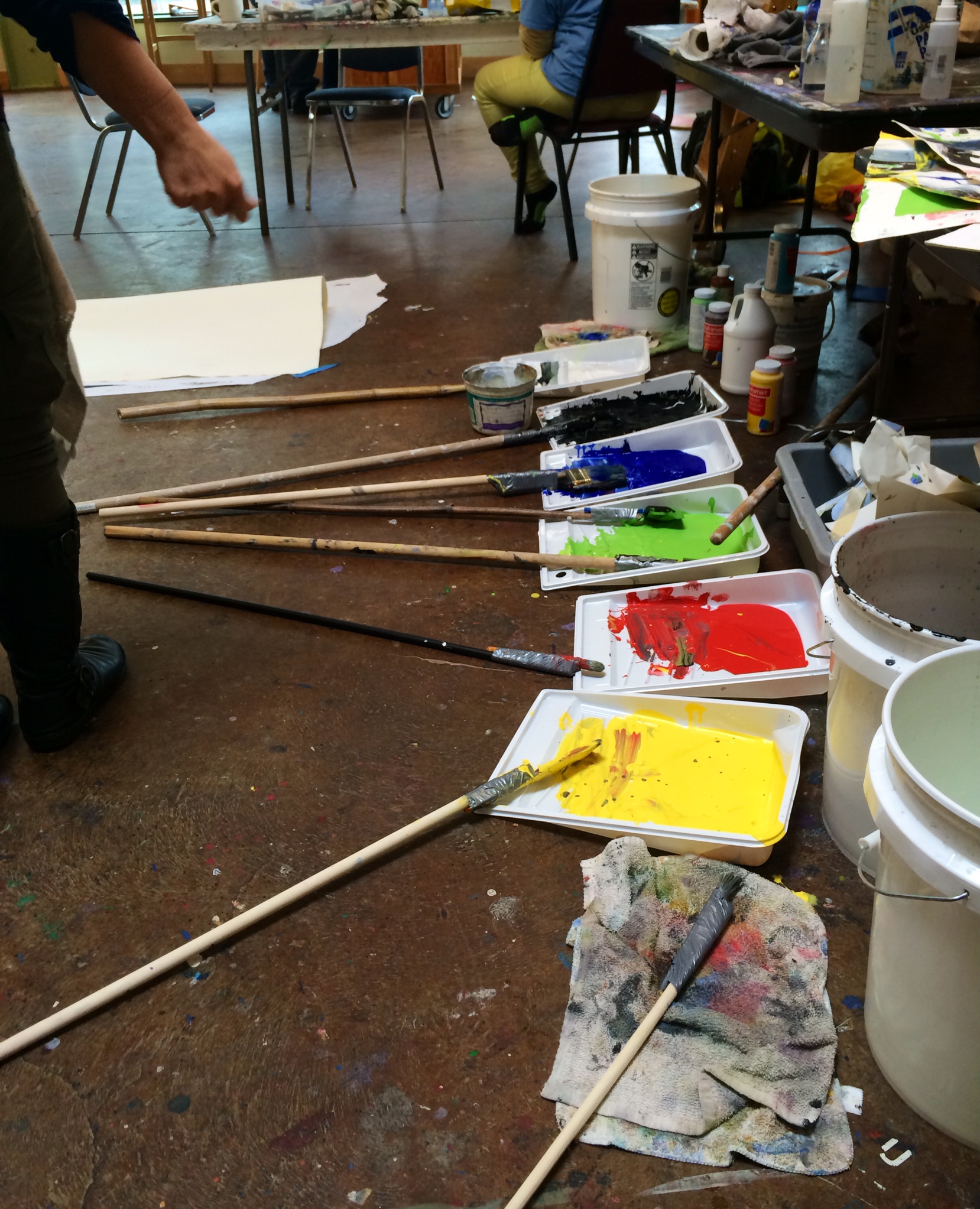
The staff was very enthusiastic to have us teaching and thought our idea would be a winner.  Our exercise had to do with letting go, playing–loosely painting with long-handled brushes (4 feet) made up of several materials like foam, bristle, chicken feathers, etc. on large sheets of good paper rolled out onto the floor. Music was supplied so a sense of the dance might emerge and engage.  Visual elements both in the form of plants and dried flowers and photos of nature were tacked around the working space.   Playing and imagination were encouraged with thoughts of nature as a place of solace.  Energy and connection in mark-making was lauded.

Phase two of the exercise was to use a mat to frame pleasing compositions within the large, colorful piece. Then they were cut out for further refinement with paint and other media.

One person had interest. Only one of the youth had the focus and impetus to even want to pick up a four foot long brush and dance around a large sheet of paper. (The staff and volunteers were dying to try.)

This hit me hard.  Although the p:ear folks said that just having that kind of creative energy in the room was their goal I felt as if we failed.  We instructed staff and volunteers who thought the exercise was a gas, but it didn’t seem to touch the youth. I thought we had designed our project well with room for random creative bursts—no skill set required— and then an opportunity to teach some basics in the small scale work with lots of room for individualism.

Later it occurred to me that much of art-making for me is about exploration.  The very word implies time and the unknown.  Having the time to discover and uncover and be led down unexpected paths, taking risks and having the opportunity to overcome obstacles is what is most exciting to me about painting. These kids do not need any more risks or unexpected paths. And although they have plenty of time, they also have plenty of obstacles. Our next workshop in a few weeks will focus more on more prescribed tasks with assured outcomes.

In my own work and what I want to present to the class is the opposite.  I want to practice trusting the risk. It isn’t automatic.  As much as I believe that exploring failure is an opportunity for the unexpected to rise up and become something new, it takes discipline and time and a willingness to let go of expectations. These are both necessities and luxuries in our work. It’s a problem-solving adventure in which overcoming obstacles is, lucky for most of us, about discovery and not about survival.

.1. set up 2. some inspirtation and a cut-out from the whole. 3. painting on the floor. finshed piece in red

Posted in Uncategorized | Leave a comment

Roots and WIngs

I know I write about the same stuff over and over again.  But I can’t help it.  It haunts me.  I’m not alone.  There are volumes written. Here’s more.

There’s this paradox in art making.  The best stuff comes when you don’t care about outcome.  On the other hand the best stuff requires a connection to something larger than yourself that you care about deeply. Something that calls you to inhabit it–to hang onto it.

Perhaps it’s similar to raising children.  You love and care so much that it can feel like your heart is slashed open and an electric current connects directly to them. You are afraid for them always. Be safe, do right, and don’t get lost. Come home so I know you’re ok. But in order for them to thrive and grow into who they need to be, they need to be set free of your expectations and control.

A client of mine recently posted an anecdote about making paper plate turkeys for Thanksgiving with her 3.5 year old daughter.  The mom is smart, well-disciplined, marvelously creative, a great baker, decorator and business woman.  As she “perfectly” placed the cut out pieces of colored construction paper on her plate she then went to “help” her daughter by re-arranging her placement.  Pretty soon the daughter handed her mom the paper and scissors and glue and said “You do it mommy, I don’t know how to do it right.”  And we wonder where our inner voices come from. (The mom, by the way, was taking this as a big lesson for herself.)

Elizabeth Gilbert, author of Eat, Pray, Love, describes fear and creativity as conjoined twins. She accepts the fact that as her creativity stalks uncharted territory where she may find herself naked in front of the world, fear hovers. It can be debilitating, almost smothering. She likens the creative journey to a road trip with the two of them, but says: “Fear, you ride in the back seat.  You don’t get to decide anything on this journey.”

These are the reasons behind most of my goofy exercises. What may seem to be a frustrating, hard to follow exercise is designed to keep you safe distance from your creativity’s partner.   It allows you to absolve yourself from the responsibility of failure and hopefully let the “exquisite portion of your life” be passed along for others.

Mary Chapin Carpenter talks about doubts and fears in her song Jubilee—“they can’t add up to much without you”. You give them life and breath so it’s hard to squelch them.  But without your permission, they can’t exist. Perhaps the idea of turning over control of the process to a ‘list of directions’ can simply side-step the fear. It does work for me.  It takes me down roads I did not map, but that I can navigate. Try making up your own.

Leonard Cohen on accepting an award for his songwriting said: “Poetry comes from a place that no one commands, that no one conquers.”

The trick is to occupy that “place” whatever it is for you.  You must reach for it with diligence and discipline, but without expectation and control.  That’s a mighty trick! Trust there’s a force, a synchronicity, of which you are welcome to become a part.

Be willing to give your work roots and wings, like we give to our children. Both are of equal importance.  You must care, you must connect, but you must also let go and trust.


Posted in Uncategorized | Leave a comment

Senses and Sensibilities

Painting, painting, painting—deadlines, mind whirling– is it any good? Can I be done with this batch? This is not the way to do it– always painting for a deadline, a goal. It should be exploring, experimenting.

I’ve had a rich week or so where time in my studio was paramount. It turns out that not fully reading mail makes deadlines a surprise.  No time to think about it, just go.  So “go” I did and oh the things I remember.

Mostly I now recall how concentrating on painting day in and day out means that I live in a never ending state of attentiveness and curiosity. Nerve endings seem to sizzle.  I startle when suddenly someone is in the room. My focus is so intense that I don’t hear anything outside of the background music and my thoughts scattering from one influence, one painting to another and another.

I dream the paintings and fight the urge to run downstairs after I’ve gone to bed to turn that passage into blue or this other one red, or what if I rub it with bronze?  I take photos with my phone and look at them before falling asleep with eyes squinting almost shut.  I edit them with the filters making them black and white, or “noir” whatever that is, and I analyze the balance. I am consumed.  I want to read more, see more, mix more color!

Then I question. What are they about?  Do they have any meaning?  Do they resonate?  What’s the point? The last piece that I liked very much that came so easily last night now, the next morning,  seems cheap and tawdry.  Maybe I shouldn’t have varnished? I think they’re too shiny. OMG, WHY BOTHER?!?

The photographer came and as I prepared for his arrival looking at all of the work on the wall I felt a mystifying mix of pride and interest— which one looks best next to which? Do they relate?  How fascinating that they change when simply arranged in a different order.  When I lead photo-genius, Aaron, into the room my stomach suddenly flips and what pride I felt is quickly lost.  It all looks SO childish!!!  I feel embarrassed.

Yet at the end of the day, after dinner and a little break, I find myself with an online color mixer seeing what happens with magenta and teal in different quantities. I resist the urge to go and try it with the actual paint. Stop already and take a shower!

I have two upcoming exhibitions with locally renowned artists. I look at their work online. For an instant–Ohhh, mine’s better than that!!  Then quickly, Oh no, mine is awful.  It’s insipid and without mastery of any kind.  Who am I kidding?  Then I remember that Cezanne or Cervantes or Shakespeare said “Comparisons are odious”(actually, Dogberry in Much Ado…says “comparisons are odorous”)—urrggh, how do I fit into this world?  But wait— look at how that cad yellow-light and the ochre play with each other on the TV autumn leaves. And those pumpkins!! What is that orange anyway?  I’m hooked again.

I’m not sure if this is what creating is like for most people, but I suspect that it is at some level. Perhaps it’s the flickering back and forth that gives the work its force? Despite any self-doubt, the level of engagement in life itself that art-making offers me is so intense that to live without it would seem stifling. There is little I experience that can offer me this level of passion.

I still wonder, however, how you know that the work has meaning, content and resonance—authenticity– the thing that elevates it above wallpaper or greeting cards. I honestly don’t know the answer to that. But I do know that if I have 3 or 4 paintings on the wall, despite occasional differing opinions, most people gravitate toward the same piece.  One rises to the top.  I’m convinced it takes doing all of the others to get one to float off the table as they don’t all have magic. I keep thinking that perhaps I will figure out how to make the magic more reliable.  And maybe more time in the studio will do that. But if not, at least I will know this incredible feeling of heighten sensibilities is available next time I let painting be a priority.

Posted in Uncategorized | Leave a comment

Wild Again…

I was going to try and write a SIMPLE paragraph about color. Can’t do it.  It is so complex.  There is Newton and cones in the eye and the length of light waves and then there’s Goethe and his color wheel, etc. and psychology and chemistry, etc., etc., etc.  That’s why I just have hundreds of tubes of paint.

I’ve presented color lessons in the past and I think they are vale valuable, but for now I’m just going to give you these links to 1) a commercial video that introduces Josef Albers – http://vimeo.com/12775814 (a short and sweet version–just a couple of highlights) and 2) http://www.youtube.com/watch?v=8YpZX0Xj9-Y- (a longer, more academic look at color that includes an iPad “app” and a nervous Yale professor—it’s a little painful, as she is so slow and awkward, but it’s really good stuff).

In addition, at the request several class members, I’m going to list tubes of paint and their makers that I like and why.

These are some paints I can’t live without:

FINITY—Davy’s Grey and Olive green. Finity is made by Winsor Newton and I really utilize it for its transparent characteristics. These colors are both on the warm side of the spectrum, but are neutral. They are great for modulating passages that are already on the canvas that need to get a little darker, but not cool, or grayed-out like black can do. (They dry much darker than when they first come out of the tube, so beware.)

OF COURSE—Quinacridone nikel azo GOLD.  This is the “magic” color that makes everything look like a renaissance painting.  (Think Rembrandt—yes, do think Rembrandt–always.) Golden is my preferred brand, but the Liquitex Acra Gold will do, especially if it’s on sale.

I like Golden Quinacridone nikel azo YELLOW also. This is very transparent. It is an acrid, yellow green or green yellow, take your pick, that mixes beautifully and stains yellow green.  Think intense, low sun, when rolling hills glow.  It mixes with Thalo Turquois (or sometimes just known as turquoise) about 10-1, to make a lovely, transparent blue-green

Golden also makes a transparent color that is great for adding soft, warm glow.  It’s a pinky, coral, red called Quinacridone, Red, Light. Very different than any other red.

Golden, again, is my favorite for Ultramarine Violet—other companies make similar colors of different names. This is my favorite.

For a ton of fun play with Golden’s color mixer: http://www.goldenpaints.com/mixer But be aware that the colors don’t really look like the colors in real life. It’s still fun.

Liquitex makes my favorite Turner’s Yellow –think Turner—his yellow isn’t too gold, or orange, or green, or lemony or chalky.  It’s not intense, like cadmiums or Hansa.  Some may think it’s a little gray, but it works well for landscapes.  It’s highly pigmented, translucent with a satin finish.

ANY BRAND—

Paynes Grey, a dense, cool, dark blue grey, mixes beautifully with anything and stains to give a beautiful patina to any color already n place.

Indian Yellow – a warm, almost orange dark yellow, very transparent but highly pigmented.  I use this color maybe more than any other single color.  I buy the Golden liquid just because the pigment is rich and it is transparent—this color will WARM up anything, but is not as dark as the magic color.

Primary Red—reds are so hard to mix and technically magenta is what mixes best, but sometimes you will see this color and that indicates it is meant to mix.  It’s helpful to have a mixing red. When you use what looks like primary red, like Napthol, mixed with cyan or ultramarine you end up with a brown.  (It will mix with cobalt blue for purple though.) So any color labeled “primary” is designed to mix a clear, “color wheel” kind of result.

Sap Green—This is a fairly dark green, transparent usually, and not too blue, like Hooker’s.  It’s closer to olive, but without so much black. Mixed out with white it makes a Khaki green.

Red Oxide—Not every company makes this, I know that Liquitex does.  It’s a very earthy orange/red.  Oxides come from iron so think “grand canyon” orange.

Lastly, there is a paint I’ve only begun to try. I think I like it. It’s Atelier brand by Chroma. http://www.atelieracrylic.com/atelier-interactive  I’ve only bought a couple of these, but the one I reach for frequently is red-gold. It’s a sumptuous, intense warm color that really adds punch. Another color they make is called red-black. You can make this color by mixing, for sure, but oh to squeeze it out of the tube—yummy.

All of this talk of paint makes me want to get into the studio—I’m on my way….

Posted in Uncategorized | Leave a comment