A True Aim

As we lean toward the “getting done” instead of the “doing,” in this season of art-making, it is still critical to keep an eye on the quality of the encounter. There is no substitute for true engagement in the paint, the mark-making and the seeing. Any product that results from a skillful but unemotional, unconnected approach will be inferior.  The quote on the wall—“The quality of the product is inextricably linked to the quality of the process” is our mantra.

Research supports this idea, indicating that being involved in an activity without extrinsic rewards (money; reputation; gold stars) leads to greater satisfaction and a better result.

Studies in creativity by Teresa Amabile at the Harvard Business School led to: “The Intrinsic Motivation Principle of Creativity. People will be most creative when they feel motivated primarily by the interest, enjoyment, satisfaction, and challenge of the work itself, and not by external pressures or inducements”. In these studies researchers asked artists to select a total of 20 paintings –10 were commissions and 10 were from the artists’ regular practice of painting without knowing the outcome.  A panel of curators, knowing nothing of the nature of the research, rated each work on both creativity and technical skill. The non-commissioned works consistently rated higher on creativity regardless of the level of technical skill. A comparable experiment by the same researchers with writers and poetry had similar results.

Likewise, the joy of doing leads to greater quality of life in general.  Recent studies on the subject of happiness advise buying ‘experience’ rather than things. According to Elizabeth W. Dunn, an associate professor of psychology at the University of British Columbia, it is true engagement in activities that leads to long-term happiness.

So let’s concentrate on the quality of our engagement along with our scrutiny. In this time of Valentine’s, while we analyze and critique, let’s also fall in love with the color and the charcoal.  Let’s dance with the brush, (but don’t lead all of the time). Let’s foster the intrinsic value of the painting process despite the need to think about mats and frames, etc. Let’s focus and bring the marks “from that place where conviction lies.”

Formulas for this seem to be in short supply. It doesn’t come from reaching too hard or analyzing too much or trying to get it right.  You have to prepare and then let go.  You know it when you’re in it. Things happen on the page that are unexpected and you are aware enough to notice their value. You can’t hear the mindless chatter. Time flies. As Meryl Streep said in her recent “60 Minutes” interview: “When you’re doing it right there is a thrilling suspension of the day to day.”

As we continue to prepare for our open studio, don’t forget to “open you”. Take risks. Do what it takes to engage fully and wholeheartedly.  Get something inside to stir. Keep the wonder alive.  Maintain a spirit of discovery. And most importantly, avoid the urge to look at your creative endeavor as something else to check off your list.
Posted in Uncategorized | Leave a comment

On Being Rothko

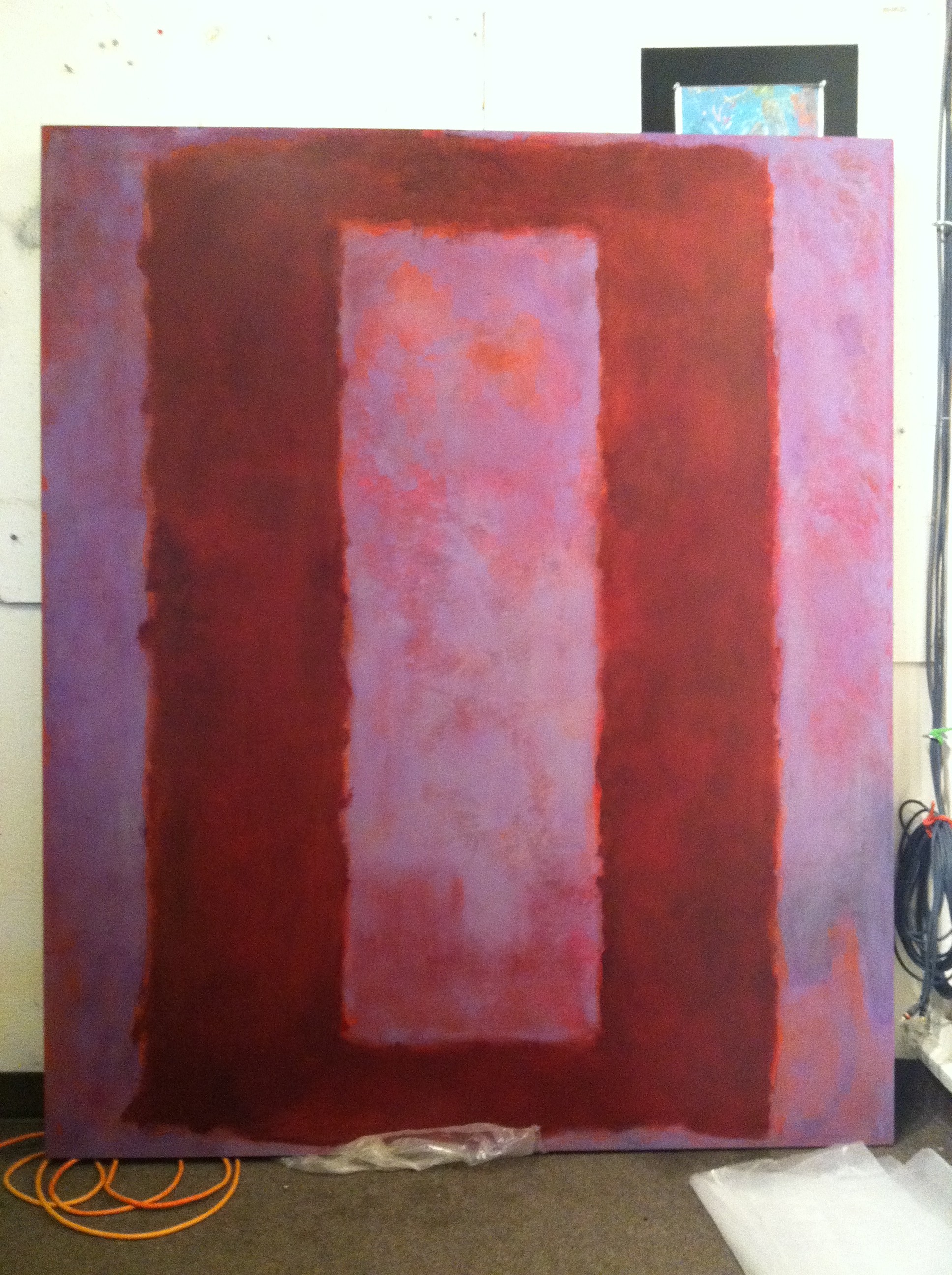
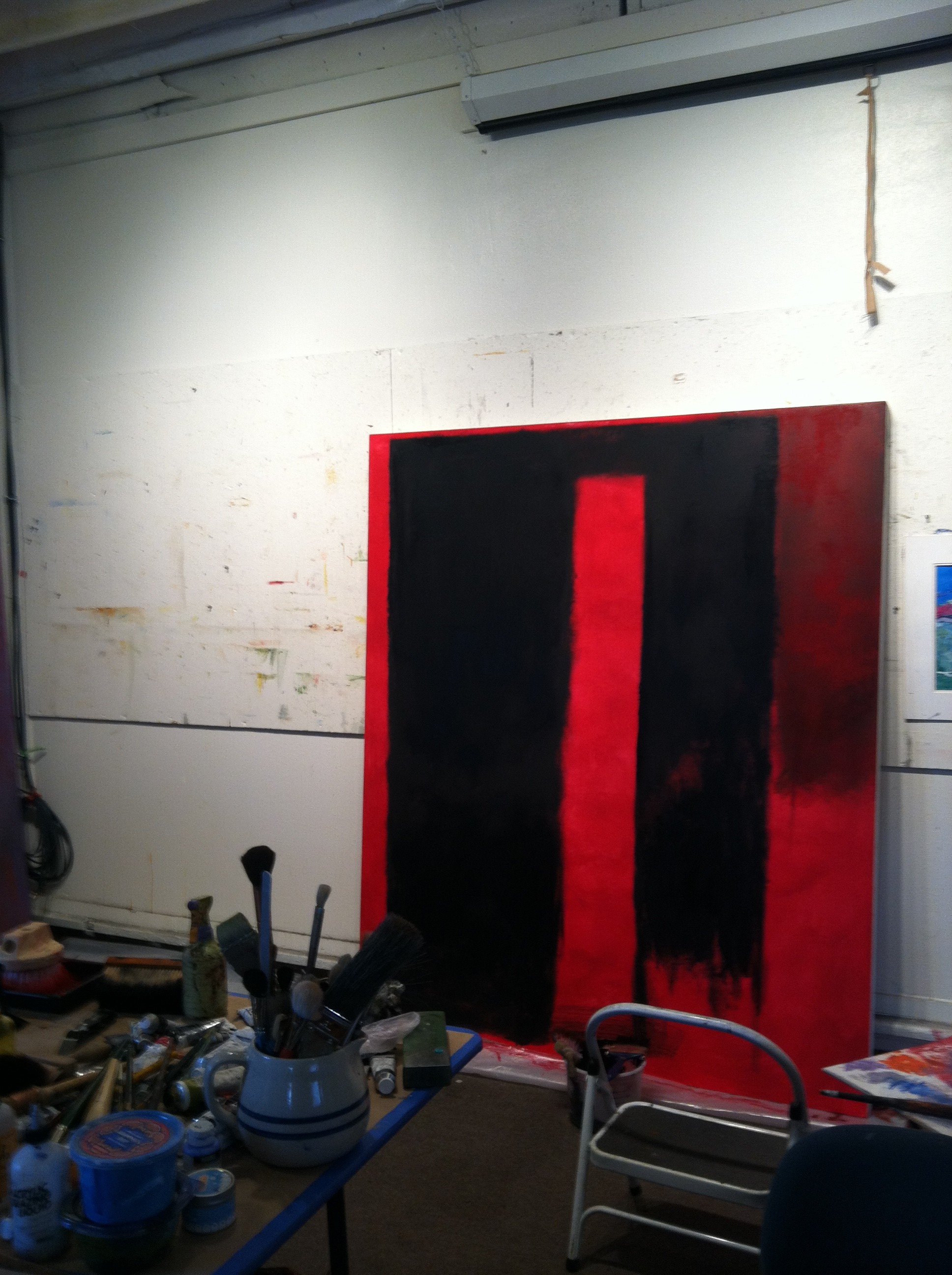
Seeing a large color-field painting as a teen I was incredulous at the notion that “this is art”. From there to here and now, re-creating one of those luminous monsters, has been quite a trip—literally and figuratively.

In the early 80’s there was an exhibit of Mark Rothko’s Works on Paper at the Portland Art Museum.  Determined to discover why these bands of tone and color mattered, I headed to the museum multiple times.

The first visit was one of stopping to read all the reading that museums typically provide, looking at an early watercolor of Mt. Hood from the Rose Garden and puzzling over some tempera sketches for the Harvard murals–all an academic struggle to gain insight.  Then I rounded the corner and fell into a room filled with black and gray rectangular images that literally made my knees weak.  That is not an exaggeration.  The impact, for whatever retinal, biochemical, or recall reason, was such that I HAD to sit down.  It was remarkable.  It was as if a video instantly flashed before me reflecting the history of art, or the history of man, or the depth of the spiritual, or perhaps my own dark soul, or my Pollyanna sense of optimism—I can’t explain it, but it was all-encompassing. I revisited the exhibit several times and every time sitting in that room was like taking a drug.

Many years of books and exhibits from NYC and DC to London and Rome  and miscellaneous individual paintings to the Rothko Chapel in Houston my understanding and appreciation of the work of Mark Rothko continues t0 deepen. At the same time his work brings up many questions about art, its meaning, its creators, philosophy, how color, light and form function on a 2-d surface, etc. And as I reproduce his work for the upcoming Portland Center Stage production of the Play by Jonathan Logan, “Red”, those questions continually run through my mind.  But in the end, it is simply the layers of those saturated colors creating velvety surfaces that are somehow transformative.

This is where he and I meet.  Whatever our commonalities of geographic ancestry and the impact of life in Portland, love of the theater, our similar politics (even naming our daughters the same name), they are coincidence.  I believe we share a level of thrill when colors meet, overlap and vibrate. Finding just the right viscosity is compelling.  I itch to get back to them after a break.  There’s no doubt he will continue to influence my work in an even bigger way. (It may be time for form to dissolve again.)

This week and next we will be working on the pile of pieces in progress.  Suggestion:  find an artist with whom you really resonate.  Look at one thing—one relationship, one technique, one passage that you find thrilling.  Copy what that artist does on one or two areas of your paintings as you work to resolve them. I hope you have as much fun as I’m having.

Posted in Uncategorized | Leave a comment

Why Paint?

Maybe it was the reoccurring patches of blue in the sky. Or maybe it was the hours of staring into luscious layers of Alizarin Crimson.  Or maybe it was just the Dr. Pepper commercial which had me singing “I gotta’ be me” at the top of my lungs. But after a hiatus from painting, my recent emersion into the world of color, line, shape and form reminded me of the power of the brush. Anxiety and stress relief may come equally from gin and pills but they don’t provide the focus and centeredness that painting does. And it doesn’t give you a hangover.

Why is that?  The experience is not mine alone. What does one find by doing it? What happens when one puts a mark on the page?  What does it get you?  If your answer is something like “After enough marks you get a painting to hang on the wall” then you are missing the best part.

When we dare to take a blank surface and fill it with authentic marks we dare to be self-defining and we are doing it “out loud”.  Because an extension of self has become an actual “thing” the possibility of others seeing it looms large. It becomes scary, even if we are painting in the basement with the lights off.  No matter how long you’ve been creating, the armor of achievement can’t fully protect you from the fear that you might look like a fool if someone sees you, especially if you are continually finding original, honest things to expose.

When you connect with this process you are ‘right here right now’—your eyes engage, hopefully you have chosen a subject with content that will keep you engaged. You feel a response. Intuition and practice suggests you make a move. Sometimes it’s right, sometimes not. But the mistakes are not lethal, they are lessons, they open your eyes to new possibilities.  What if?

Allowing new ways of seeing that might reveal truth to you, rather than manufacturing outcomes, offers insight in other areas of life.  It opens you to the idea that what we think is the best thing, may not actually be the case.  And what’s missed in trying to meet your expectations could be where the ‘meaningful’ lies. You drink in the present, not waste the moment predicting or planning the future.  We are people who want to know the end. But no matter how hard you try, you can’t see it until you are in it.  http://www.youtube.com/watch?v=xFntFdEGgws  (My favorite illustration of this.)

Process painting allows the “end” to unfold in both expected and unexpected ways. Watching it, accepting it, feeling the fear and doing it anyway puts life in perspective for me and it almost always leads to song.

This week you will relinquish all control from knowing the end.  I will be in charge–eh, eh, eh… Fresh paper or underpainting both work.

Posted in Uncategorized | Leave a comment

The Other Side of the Coin—The Power of Words.

In Hamlet, the prince in his overwhelmed, emotional state, tries to sort out his life and is either feigning or struggling with madness. The old Polonius asks him what he is reading.  His answer: “words, words, words”.

Gertrude’s Stein’s famous phrase “A rose is a rose is a rose” is often thought to be about a thing being what it is and nothing more. (As in another Shakespeare line “a rose by any other name would smell as sweet.”)  But Stein’s comment about the phrase’s meaning is this: “…I think that in that line the rose is red for the first time in English poetry for a hundred years.”  She is talking about capturing the idea of a thing and not the thing itself.  When you read the word “rose” you may envision the rose on the towel in your grandmother’s bathroom, the last rose of the season as it fades by the front porch, or the rose sitting in a bucket at the grocery checkout.  But by the time the last “…is a rose” is uttered, your mind’s eye sees a flower with velvety, deep red petals— the archetypical elements of a rose.  Or at least that’s how it works for me and what Stein intended.

Back to Shakespeare, too deep w/ too many interpretations to mess with in this forum, but I’m going to do it anyway. Repeating  the word “words” three times is generally considered to function like this: In the first “words”– words are meaningless; the second “words” seems to say words are all we have to reach understanding; and then by the time the third “words” is spoken it becomes nod to their power. In this complex tale of the young prince and his quest for the truth, Hamlet shows an awareness of the power of words as they spin lies, swear love and incite murder.  They create, they destroy, they are true, they are false—and they’re the best we got.

With a wink to the “rule of three”, we move past it to the point—We are bound to strengthen our knowledge of our wordless journey by talking about the work and its process.  Critiques are tricky, but I, and every other art historian, teacher and critic know that the crafting of verbal language in the service of understanding visual language is a rich and useful endeavor. It informs. It unearths. It broadens ideas. And it’s all we got.

Guidelines for offering opinions have been suggested so I propose this one, with a major caveat: wait for the talkback time or to wait to be asked for an opinion before offering one.  But how often have you been struggling with something and encouragement from another has propelled you forward, or you’ve been working in silence and you realize no one has said a word so you begin to doubt?    In my own work, there are times I ask for my studio mates’ opinion, but then other times I wait to hear if they have anything to say as they walk by. I am grateful for each observation.

So what are we to do? Use your best judgment.  Weigh these thoughts and those of last week and know that words have power that can go both ways, but they seem a necessary component to the process.  Keep in mind that many people prefer working in silence and some people really don’t like to be interrupted with an opinion, (or with idle chatter).  For my part, I will try to say nothing unless it appears you are heading into a trap or you’ve hit on a good thing.  But if I am reading it wrong, speak up and we’ll talk about it.

Posted in Uncategorized | Leave a comment

Every Picture Tells a Story

In the Alfred Hitchcock movie “Suspicion” Joan Fontaine suspects her new husband Cary Grant is trying to kill her. As her mistrust grows the images and the actions build the tension. When Grant is simply carrying a glass of milk upstairs to her bedroom the suspense mounts. One reason–the clever director put a light INSIDE the glass of milk in order to focus the viewer’s attention on the glass. With every step the audience wonders–is there poison in it?

Wassily Kandinsky, 20th century painter and art theorist, believed that the emotional power expressed in a painting not based on the literal or the descriptive allows the viewer to employ their own imagination and create their own story resulting in a greater emotional impact.

Bonnie Greer, American born, British playwright who is on the Board of Trustees for the British Museum says this about an artwork: “The subject is the excuse to transmit something inside the artist that is deeply, deeply profound.”

A not uncommon thought: the more questions that a work of art asks, the better it is.

Nietzsche says- “That for which we can find words is something already dead in our hearts.”

If we combine these thoughts relative to the painting process it becomes one of: transmitting something profound from one’s deepest interior that the artist creates to stimulate the imagination and elicit an emotional or intellectual response that leaves the viewer with many questions that should probably not be uttered.

Now let’s discuss….

The point is, in the visual language we are learning there are clues in every painting that open the door the artist’s vision.  These clues, intentional or not, can even inform their creator about the illusive quality that is in any painting worth its salt. We can unearth and begin to understand them by talking about them.

Asking “how” a painting works is a good start. There are mechanical ways in which a “picture plane” functions. Shapes arranged in certain patterns cause interest, lines and objects lead the viewer around the page, colors recede or come forward, contrasts command attention, resting spots create a sense of space, etc.  We practice seeing and describing these mechanics to become more fluent in the language.

Then there is the narrative that cannot or should not be ignored.  Manet would be quite insulted if you thought his “Luncheon on the Grass” was about lunch, or his “Olympia” was an idealized nude (to see both: http://www.impressionniste.net/manet_edouard.htm ). In these paintings there are stories. And the viewer contributes to them by interpreting the image. When they were painted there was much outrage and dismissal of these artworks that began a dialogue that continues today. Manet’s response: “I paint what I see, and not what others like to see” .

It is easy to be unnerved when the story trying to be told is miss-understood or  an amorphous shape in a painting is described as a ‘this’ or a ‘that’—completely contrary to the artist’s vision.  Once voiced the creator often has trouble ignoring it.  But in order to glean and grow it may be necessary to accept that the viewers’ imaginations can run wild and, insensitivity aside, telling what they see may not be a negative to them. As we strive to learn this complex language, it is important to stay open to response and at the same time strengthen those wobbly legs by standing by your work.  As viewers, practicing the words that best describe what you are responding to will increase your fluency allowing our stories to grow more and more meaningful.

Posted in Uncategorized | 5 Comments

Aaaaahhhhh….

The year 2011 for ArtHouse 23 was a big one.  We saw a 25% increase in new members; the birth of a new gallery; a group show outside of our studio attended by people we don’t even know; all of the studio spaces in the Big Yellow House belonging to ArtHouse folks, enriching the day-in and day-out of studio time; and our first European art trip.  Quite a year!  Cap any year with the usual holiday frenzy AND a local sport’s team victory in a prestigious game that causes nail-biting, yelling and cursing; and a sunny morning on the 3rd of January warrants a big Aaaahhhh and some reflection. 

To a person, the growth of the work in the last year has been notable.  Each and every one of you have reached to express, with your own voice, all the many approaches to the painting process that I’ve thrown at you.  We’ve moved from basic design and color exercises to figure work.  Then we’ve tackled collaborative exercises; calming exercises; exercises to throw you off balance; exercises to put you in balance; sprinkled in a bit of technique—metallics; collage; charcoal; powders and potions, perspective, etc.  A little art history and learning about artists we love to love have added influence. We’ve written artist statements and worked on developing your ideas in your own visual language along with assimilating the ideas of others.  It has been a well-rounded, busy year and your work represents honest efforts in embracing that which resonates for you.  That’s the key—keeping in touch with what is personal and important regardless of what I cast your way. You’ve boldly demonstrated two of my favorite maxims:  “Notice What You Notice”; and “Question Authority”.

The group has a life of its own. It’s a heady brew and I am grateful and proud that every individual adds to the whole.  The Whole, which is worth more than the sum of its parts–what a gift of community we share!

With so much under our belts going back to basics seems like a perfect start to the New Year.  You will need a FRESH SHEET of paper, not smaller than 16”x20”. Think about format—sq or a rectangle in a standard frame size.  Bring an image that elicits an emotional response and that you can make into a good composition. Or find one from our source piles.  Take a deep breath and lets dive into 2012 together.

Posted in Uncategorized | Leave a comment

Steep, Steeping, Steeped

One of our generations’ great abstract painters, Helen Frankenthaler just died at the age of 83. She is quoted as sharing a common mantra at ArtHouse 23: “There are no rules. Let the picture lead you where it must go.”

Despite all its required freedom and complexity, the painting process has a somewhat predictable progression.

The impetus to pick up a brush begins with noticing some impact from our life experiences.

Our imagination is employed for the generation ideas and/or making connections that begin to layer upon the substrate.

From there it is a back and forth rhythm of evaluation and bursts of creative impulse. Practicing the exhilarating balance between what goes on in your head, on the page and in the gut can be equally as frustrating as it is seductive. The results will almost always be unexpected. New doors continually open when it’s going well.

This week we continue with the piece begun from a specific idea.  Now that the idea has steeped and there is a picture in progress to lead the way, the next step is the looking and learning what it may be about and where it will go.  One more class on this piece, then a new exercise for the New Year.

Posted in Uncategorized | Leave a comment

Christmastime Creative Collaboration

Creativity– the ability to use the imagination to develop new and original ideas or things, especially in an artistic context.

“An idea is more than a single thing. On the most elemental level an idea is a network. Inside your brain a network of neurons form as ideas develop.” (Steven Johnson: Where Good Ideas come from.  Below is a paraphrase of his TED Talk.)

How do you get your brain into environments in order to enhance or make this new network pattern? Breakthrough ideas more often than not are cobbled from what we have available—from the road signs we pass, to the kitchen catch-all drawer, to the people we overhear in the coffee shop and from the people standing next to us with whom we can brainstorm.  We look and see what we have around us in order to form new ideas. What does innovation and deep thinking really look like? –A chaotic environment of conversation and reflection, a discussion of mistakes and successes and a pulling together of threads from multiple sources.

This week our holiday party will be a ‘chaotic environment’ where collaborative creativity will ensue.  The subject will be the following quote:

“Live in the sunshine, swim the sea, drink the wild air.” ― Ralph Waldo Emerson  In groups, you will develop a 2-dimensional image to express Emerson’s quote.

Posted in Uncategorized | Leave a comment

Pondering

“Art must do something more than give pleasure.  It should relate to our own life so as to increase our energy of spirit.”  Written by Sir Kenneth Clark in a series of articles entitled Looking at Pictures in the London Gazette

As you ponder the “idea” on which your painting is created, heed a little advice from Robert Genn (you can find his newsletter online):

“Don’t be afraid to fall back and take your own counsel. You are the only person you will have to live with significantly, and you may as well get to like and trust yourself.

Always be open and curious as to what you may be doing wrong. Little wrong things that you can get to like can send you on the track of something new or original.

Wear a different cap when you sit back and contemplate your work. You’ll notice nuances, touches and subtle ideas that were not evident when you were in the middle of it.

Be prepared to take risks. You need to be able to get your brush around what you’re up to, but if you don’t swing out, you’ll never know what’s out there.”

The most important of these is the last.  As we continue with the works in progress, take risks, change in mid-stream if it seems like your idea is not working, allow the idea to develop with careful thought.  Keep in mind the quote by Kenneth Clark. (Director of the National Gallery in London 1933-1945 and the writer and presenter of the 1969 BBC2 documentary, “Civilisation”.)

Posted in Uncategorized | 1 Comment

Every Picture Tells A Story

On wall after wall in museums and galleries hang story after evolving story.  Until the Realism of the mid to late 19th   century and the Modernist painting of the 20th century most visual art in Western culture was designed to communicate a very specific message. From cave art that was used as talisman, to religious art professing the power of God and the church, to art about the political powers that be, to the portraits of the rich and famous, the meaning of visual art seemed to tell a tale of the subject’s power. Visual literacy meant understanding certain symbols and thematic concerns putting everyone in their place and teaching them how to behave.  To most viewers in whatever the period in which the art was created, the messages were clear.

Development through the late Renaissance to the Industrial Revolution continued to bring more freedom and equality for the populace. And with it a new sentiment regarding art emerged. Oscar Wilde in an 1891 issue of the Pall Mall Gazette wrote:  “A work of art is the unique result of a unique temperament. Its beauty comes from the fact that the author is what he is. It has nothing to do with the fact that other people want what they want. Indeed, the moment that an artist takes notice of what other people want, and tries to supply the demand, he ceases to be an artist, and becomes a dull or an amusing craftsman, an honest or a dishonest tradesman. He has no further claim to be considered as an artist.”

This view, as you all know by now, is where I live and from where most of our exercises stem.

The contemporary discourse around art, however, is once again centered on the preconceived message. Not that the  message is to necessarily satisfy some demand, but art’s merit for today’s critics is found in the quality of the idea behind the image rather than its formal appeal or even its visual impact.

Conveniently for us we have a fast food explainations of this in the TV show “Work of Art—The Next Great Artist”. Where we usually follow an impetus set forth by either a compelling model or the attributes of our materials, all the young artists fresh from art school on that show begin their work with an idea.

This week we are going to follow their lead and create a work of art relating to an idea thought about ahead of time.  We will be working on this for the next two weeks and the week after Christmas.  So take your time to think about something you want to say in a painting.  Then figure out ways in which you might communicate this thought.  You will need source material and media specific to this predetermined message. I know there are groans about now, but just think of it as a challenge.  Let ideas roll around in your head for a couple of days then we can bat them around in class. Some of you like Susan and the two Lauras do this very naturally.  Others will have a tougher time.  But it is a muscle that needs flexing in order to be relevant.  And if you don’t want to be relevant, it’s good for brain function.

Remind me to point out a noteworthy result from last week’s episode and of the dichotomy of art practice.

Posted in Uncategorized | Leave a comment