Mixing it Up

We’ve established that color communicates mood, emotion and space.  It has a push/pull effect that can make a colored surface pull forward or push back. It mixes in the eye to make new colors. A colored ground or a thin glaze on the top of a painting often serves to unify the whole and adds depth to the work. Repeated color helps create surface harmony and lead the eye. Color that “clashes” creates tension and color interacts with color to some surprising effect. Using the color wheel can act as a guide but experimenting is probably the best way to get a command.

Paint is pigment mixed with a binder.  Historically pigments were made from ground minerals, oxides, carbon and lead. Mixing these elements involved great skill because their production and interaction left the end result unpredictable and unstable. (Simple history primer of pigment from Winsor Newton- http://www.winsornewton.com/about-us/our-history/history-of-pigments/ )

Now much of the muddle of paint-mixing is taken care of with the modern manufacture of paint.  There are some principles that are handy to know, but most useful knowledge of paint-mixing, in my opinion, comes from trial and error with attention paid to the results.

Here is a link to an “About” post by Marion Boddy-Evans that is a good sum-up of color-mixing. http://painting.about.com/od/colourtheory/ss/color_theory.htm It’s nine pages long and has a lot useful info. But I find it hard to get through because I am impatient and all I want to do is start squeezing the tubes and watch the colors dance.  If you’ve seen my collection of tubes you know I don’t spend a lot of time mixing.  But because I’ve done it enough, I usually know what I need to combine with what in order to get the desired result.  And if it doesn’t work, sometimes I just change directions and that’s ok too.  For me, it is the discovery in painting that I find alluring, so I’m not necessarily tied to the results.  But if you feel more comfortable with knowing, read the two links (and then share what you think is most enlightening.)

Posted in Uncategorized | Leave a comment

Color Me ________(your name here).

As we hone in on the impact of color we hopefully get closer to true expression by using our own feelings to dictate its use.

Wassily Kandiinsky,  the Russian painter who sought to define abstract art in 1912 wrote On the Spiritual in Art in which he examined the science, the psychological and  the physical effects of shape, line and color on the viewer. His thoughts on color:   If you let your eye stray over a palette of colors, you experience two things. In the first place you receive a purely physical effect, namely the eye itself is enchanted by the beauty and other qualities of color. You experience satisfaction and delight, like a gourmet savoring a delicacy. Or the eye is stimulated as the tongue is titillated by a spicy dish. But then it grows calm and cool, like a finger after touching ice. These are physical sensations, limited in duration……(sic) Just as we feel at the touch of ice, a sensation of cold, forgotten as soon as the finger becomes warm again, so the physical action of color is forgotten as soon as the eye turns away. On the other hand, as the physical coldness of ice, upon penetrating more deeply, arouses more complex feelings, and indeed a whole chain of psychological experiences, so may also the superficial impression of color develop into an experience…. And so we come to the second result of looking at colors: their psychological effect. They produce a correspondent spiritual vibration, and it is only as a step towards this spiritual vibration that the physical impression is of importance…. Generally speaking, color directly influences the soul. Color is the keyboard, the eyes are the hammers, the soul is the piano with many strings. The artist is the hand that plays, touching one key or another purposively, to cause vibrations in the soul.

He also wrote: The sound of colors is so definite that it would be hard to find anyone who would express bright yellow with bass notes or dark lake (a dark, blood, red) with treble…

And indeed—dark paintings are associated with moodiness and drama, just like dark sounds create mood and drama—think Wagner. And pastels and bright colors have their own sensibilities—what kind of music would go with these?–definitely different moods. Just as music affects mood, color has power and influence over us—visualize rooms that are painted bright yellow, or dark red and how they influence.

And after seeing the work of Albers and Hofmann, we know color has an interactive effect. It creates not only mood, but space and tension.  Hofmann’s students were called “space cadets” because they learned how to manipulate space through color and form (not using perspective.)

The trick is to harness that power and make it meaningful in your own work by creating balance, harmonies, tension, and a center of interest while responding to your own sensibilities. Susan Rothenberg states that “Red is just part of my internal palette.”  For a long time I gravitated to the darks and the neutrals.  This last show, I couldn’t stay away from oxide, pinks and flesh tones. I’m not sure why, but I do not it was important to follow that instinct.  We all know Sheila is literally lifted by green. Do you have an “internal palette”. How might it reflect or symbolize you?

Pay attention to the colors you want to grab and use them.  Then use the knowledge gained by practicing color placement to manage the movement and vitality of color and create space, and move the eye rhythmically through the picture plane. Know that light can glow when placed with complementary darks. And, as Rothko did, starting with a colored ground can help to unify the whole as you place color on top of it.  If bits of the ground show through, it can liven what’s on the top. To make a color sing, create a reaction with the colors surrounding it.

Here are the links to the interactive exercises we did in class:

http://www.pbs.org/hanshofmann/push_and_pull.html http://facweb.cs.depaul.edu/sgrais/images/Color/contrast-circles-changer[1].swf

Try deciding how you might play with this before you get started, just so you can observe specific impacts. Attempt using only the lights and the mid-tones, leaving value out of the equation at first. Then make an equal number of shapes cool and an equal number warm. Then switch the background between warm and cool and see what mood or feeling is created with each.  Also try the black for background. Create a composition that is “weighted” toward the bottom.  Then one in which the shapes float on the ground. And here is the ultimate challenge: see if you can create a type of visual “score”, ala Kandinsky. What would the sound of a brass band look like?  A Mozart flute sonata? A Country/Western hoedown, fiddle piece?

Have fun!

“Art is to me the glorification of the human spirit, and as such it is the cultural documentation of the time in which it is produced.” -Hans Hofmann

Posted in Uncategorized | 1 Comment

Color Me________ ……

A tale of a childhood discovery– “I realized that to make an R all I had to do was first write a P and draw a line down from its loop. And I was so surprised that I could turn a yellow letter into an orange letter just by adding a line.” This was told by Patricia Duffy, author of Blue Cats and Chartreuse Kittens: How Synesthetes Color their Worlds, 

Duffy’s brain is wired in a way that is scientifically referred to as- Synesthetes Grapheme–color, a sensory cross-wiring of the brain. This is an involuntary condition in which letters, numbers and even sounds appear in color or conjure color images. Research has recently been renewed in this field. And it’s been determined that the condition is not driven by learned associations.  Even if it is, it can mean that a re-wiring of the brain has taken place over time.

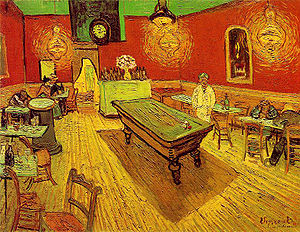
The painter Joan Mitchell, a diagnosed Synesthetes Grapheme, described the “green, of course”, of the letter ‘A’. Kandinsky’s paintings directly related color and sound, especially music. And Van Gogh talks about the use of color in his painting, The Night Café: I have tried to express the terrible passions of humanity by means of red and green. The room is blood red and dark yellow with a green billiard table in the middle; there are four lemon-yellow lamps with a glow of orange and green. Everywhere there is a clash and contrast of the most alien reds and greens, in the figures of little sleeping hooligans, in the empty dreary room, in violet and blue. The blood-red and the yellow-green of the billiard table, for instance, contrast with the soft tender Louis XV green of the counter, on which there is a rose nosegay. The white clothes of the landlord, watchful in a corner of that furnace, turn lemon-yellow, or pale luminous green.”  

We see sunsets because the light rays for the color blue are so short “… that even molecules of oxygen and hydrogen are big enough to scatter the blue rays and leave the rest alone…”, Victoria Finlay Color, A Natural History of the Palette, giving us red and orange and even violet skies when the sun’s wavelengths are the longest.

From associated learning, to the wiring of neurons in the brain, to the way the optic nerves function and the physics of light waves–how color communicates is powerful and complex and can be used consciously to influence what a viewer sees when looking at artwork.

None of this, of course, determines the quality of any painting, but being aware of how color speaks is an effective device. How color mixes ‘simply’ is useful, but how color mixes with the plethora of tubed paints available offers another set of complexities.

We will be doing a variety of color experiments over the several weeks. They will involve understanding temperature and value and will be sprinkled through the classes. Then we’ll progress to color mixing.

Because so many folks are self-directed at this time I’m going to keep the structure of the class the way it’s been for a bit and introduce exercises limited in scope so works in progress can be pursued.  If you need direction otherwise, let me know.

Posted in Uncategorized | Leave a comment

Are we There Yet?

Now that the paintings have been varnished, titled, mounted, framed and hung on the wall how many of you have wondered—what if I had done it differently?  What if I darkened the background, lightened the sky, emphasized the outlines, or cropped the painting? How do you know when you’ve done what can be done? When is a painting finished?

Jackson Pollock replied: to that question with another: “How do you know you’ve finished making love?” I’m not sure it’s that decisive in my mind, but it’s an interesting point of view.

James Elkins, Art critic and historian, School of the Art Institute of Chicago responds this way: This used to be a simple problem: when the artist had filled in the blanks, she was done. Over the past two hundred years it has become a very difficult question. Artists, critics, and scholars debate it endlessly. It’s one of the mainstays of conversation in artists’ studios. There is a lot of talk about intuition: artists say, “I just work until it feels right,” or “I’m not sure if it’s finished, but I am slowly getting the sense that it might be.” But feelings can be elusive. Many painters mull over this problem for years on end.

The discussion of when a painting is finished cannot be separated from the discussion of process. A conversation between John Stewart and writer/director Paul Thomas Anderson who wrote and directed There Will be Blood and the upcoming movie The Master, talks about the similar process of writing. Stewart asked the question: “How do you know the writing is done?”  Thomas extrapolated: “When I write and everything is going pretty well, you blink your eyes and then 10 pretty good pages have happened. When you’re desperate to try to get it right, it never is. (sic) It’s very difficult to not be precious with the words–to convince yourself to just put it on paper. I’ve written 50 drafts of things—you had it right the first time —it just sort of vomited out.  Other times, the 50th re-write made it better.  So there is this endless reach for something that keeps you hungry and wondering how does this stuff work?  It’s so confusing.”  Stewart asks “What makes you stop?” (Stewart has to stop because he has an audience waiting).  “When that is not the case, how do you not overwrite and destroy it on the back end?” Anderson says “It can’t be an endless search for ideas. But you can create situations where accidents can happen.  It’s critical to create a fertile environment –aspirational but realistic– (sic) and seize the seeds of inspiration.”

So in answering the question it might be the lack of answers that is so compelling in the process: “…. this endless reach for something that keeps you hungry and wondering how does this stuff work?

Winston Churchill (a Sunday painter) said: “The way to be happy is to find something that requires the kind of perfection that’s impossible to achieve and spend the rest of your life trying to achieve it.”

So perhaps that’s it.  Perhaps it’s simply about the striving not the stopping. About finding a fertile environment and asking questions but not expecting an answers. We stop working on a piece when there are deadlines, when we get bored with it, or tired of it, or when, as I read once, you stop learning from it. We put it on a wall or in a drawer and we start again “trying to figure out how this stuff works”.

Posted in Uncategorized | Leave a comment

Journey of Discovery

It’s one week before the work for the Remax show needs to be finsihed, framed and delivered. And one week before my exhibition is open to the public. I am used to this feeling of panic rumbling somewhere behind the solar plexis. The anxiety makes my skin touchy. I try not to think that the body of work that I will put in this show may be the one thing that says who I am. The only thing. And that this may be my last chance to prove there is any value in what I have to say. Do I have anything to say? Will it be evident in the work? Who cares? People will look and decide if it goes with the curtains or not. No one is looking for salvation in the paintings–only me.  And what if there is one painting among the whole that will be the definitive statement… and dammit, what if it is not right– and of course it is not— then that’s it!! The end of the dream, the end of—I don’t know what the hell it’s the end of. But it’s terrifying. Really terriifying. There is a part of me that is shriveling and shaking and on the verge of tears and wants to call the whole thing off. You may or may not be experiencing something similar, but these are the thoughts that creep into my psyche.  These are the thoughts I will avoid this week. If you are feeling anything similar, I advise you to do the same.

This act of expression is not brain surgery. Its worldly impact is minimal at best. And its impact should never be under consideration in its making anyway. And yet…. No, I won’t go there. I will remind myself what I know to be true about the creative process. It is an act of self-discovery. I’ve said it many times–the painting process is the microcosmic process of living if it’s approached with an earnest desire to explore and understand. We wonder, we scratch and dig and risk in our attempt to connect to something more, something bigger, something that has meaning. It is an adventure. And as long as we approach it honestly, the end result will have a beating heart. That’s all we can ask for. We (I) have to let go of any desire for acceptance and fear of failure and put one brush stroke after the other.

The following is the first draft of what is to go in the Remax catalogue. I’m wishing us all a bon voyage!

Art in the modern world aspires to transcendence. Before the advent of photography visual arts had a variety of practical functions and its emphasis was imitating life. But once the need for representing objects and people could be satisfied with the use of a camera, artwork– including art photography–evolved into something more spiritual, more mysterious, more thought-provoking and emotionally fulfilling. The purpose of art-making matured. Art became for the sake of art itself—for how it can inspire and transform, not only the artist, but the viewer.

Rather than striving to show the audience a person, place, or thing, the art in this exhibition is more about the process. It represents the ‘footprints’ in a journey of discovery that, in the words of Marcel Proust, “…is not in seeking new landscapes but in having new eyes.”  The artists invite you to walk along with them.

Posted in Uncategorized | Leave a comment

“A Rose By Any Other Name….”

Shakespeare may or may not have been right when he poetically answered the question “What’s in a name?”  But it’s a question worthy of consideration as the time comes once again to take stock of efforts after months of endeavor.

There is a practical need to identify each piece of art when it goes on display. Physical descriptions are obviously cumbersome and confusing. To say “I like that blue painting that is about-this-big and looks like the hill overlooking the winery” is ambiguous and awkward, especially when the artist says—“ I didn’t paint that, it’s the rocky cliff near Seaside viewed from a boat.” The need for a title is clear but it can be as simple as Blue # 12.

Many artists find the process of titling so distasteful that they resort a number system.  But as a viewer I find this most unsatisfying.  Even though it’s the visual impact of the work that speaks with the loudest voice, a title can whisper a little secret of what inspired the artist and facilitate a greater connection.

Choosing titles can reveal something about the work to its maker, paving the way to future work. They can peel back layers the process.  But it’s rare I remember my titles, so what does that say?

I paint landscapes.  To me they are not just a scene or a place.  There is mood and meaning in surroundings. My hope is that my work shows how a place can ignite, inspire, soothe, and heal.  How its recall reminds us of where we’ve been, what we’ve seen, who we’ve loved and who we are.

There is poetry in place.  I strive to find poetry in titles.  But then Mark Woolley says “You could name it Howdy Doody Time and few would notice”… and fewer would care.  But as a viewer I feel a greater connection with the artist and the painting when the title resonates, despite rarely remembering them.

So my task today is to title.   What will they say?  Will they help define or reveal a mystery? When accumulated will they be like a poem in which each line tells a tale but strung together they tell a bigger story. I don’t know.  My brain is dead and I am uninspired. Oh, and now I’m asked for an artist’s statement.

Maybe the question will be “what’s in a number?”

Posted in Uncategorized | Leave a comment

Row, Row, Row Your Boat…..

As most of you know my drive to scribble on walls, sidewalks and coloring books was undeniable from an early age.  For Sheila Martin, it was the making of mud pies that propelled her into creative life.  Some of us (perhaps most of us) have a drive to make, to say, to express SOMEthing.  We may not have a clue what that is, but the “itch” somewhere in the middle of the chest, or back of the throat, or between the eyes can be felt.  It nags. But it’s hard to scratch. It’s a universal feeling that has been analyzed and discussed and written about for eons.

When I was a rower my favorite boat was the “eight”.  Eight rowers, eight fifteen-foot-long oars and a coxswain in a sixty-foot-long, two-foot-wide shell balances shakily on a fast-moving river.  If the oars don’t enter and exit the water at the same time the boat is unstable. Moving forward is hard.  Muscles jolt, joints get pulled out of sockets, movement is not fluid. And there is a risk of capsizing.

But when all eight oars catch the water in concert and withdraw in unison with mighty thighs, abs and arms the boat can sit up and ride on the top of the water’s surface tension and glide forward with a sweet gurgle.

In an entire season—from March through mid-November, three-plus days a week, 8 to 10 miles a row— we might, if we were lucky and good, put together fifty strokes like that.  Stringing two or three together was exciting.  Even one lone stroke was recognized to be special. We’d analyze for hours over coffee how it happened. How could we make it happen again? Our coach was an Olympian, on the cover of US Rowing, a medalist.  She was coached by the best in the world.  It was crazy that a collection of middle-aged moms, most with no athletic background, could come together in this elite sport with an elite coach and in the dark and freezing rain experience transcendence. It was a mystery.  Discussing the minutiae in an effort to understand how each element functioned so we could make it happen again was a worthy pursuit that took up hours and hours of each week.

And in the end, we knew that, despite the work ,the  training and the effort put into understanding the function of each part of the stroke, we learned that at some point to ‘let go’ and trust was what was necessary in order for the mind and body and boat to soar.

Painting is like that. The components are many and the function of each can make a difference.  Angelina, Sheila Service and I discuss all of this regularly as we share this moment of reaching for something and being afraid of falling short.  But I watch it in me and in them and in others– the tightening.  And the one thing I am sure of is that without a combination of practice and “letting go”, without a bit of a free fall, without a belief that an expression of our authentic selves can be enough, the work will lay still. It will stay in that canyon of “competency, but who cares”. For evidence of the life that letting go can inject into a brush stroke, just look at the apples (especially Leslie’s).

I remember clearly telling my mentor that “I need to paint, not to make paintings”. That phrase came to me in the midst of a discussion on what creates “art”.  It was clear to me in that moment that the process is where the value lays, not the product. As we approach exhibition, our work will benefit by remembering how each stroke informs the next.  Treat them like “teachers” on a journey, not like a definition of who we are or what we know.

Posted in Uncategorized | Leave a comment

“I would rather die of passion than of boredom.” Vincent Van Gogh

Olive Trees with the Alpilles 1889

Olive Trees with Alpilles 1889

Looking at the California Impressionists painting yesterday at The Portland Art Museum with Angelina and her daughter Sarah was a real treat. It’s something I wish I had made time for  sooner so I could go back. (The show closed yesterday.)As we poked our way through the crowded exhibit we were all struck with the passages in the pieces that spoke to our own interests. Angelina, the lover of brushwork, was admiring of much of the active strokes.  I was crazy about the use of neutrals and how they could so easily approach mud, but instead were brought to sing by the placement of just the right neighboring color. Sarah observed content and sense of place. We all swooned over the light.

We didn’t spend time in front of every canvas. Some, of course, had greater pull than others and we each were drawn by different kinds of images, (aside from those with the stunning light, which held our universal gaze).  But the one thing by which we all were turned off was the sign of the artist’s struggle and doubt.  There was one in which the artist added a skipping light line to draw the eye, but it looked like an after-thought. It sat on top of the canvas like an accident.  Another, in which the artist obviously struggled with the shape of a cloud—a hard edge with two tones of muddy gray on either side—it was clear that the artist did not win the battle.  And in another a green patch needed a touch up, but the painter could not duplicate the surrounding color, so instead of integrating, he allowed an obvious blob, with no connection to the rest of the piece, to sit there.

Sarah, a young artist in her own right noticed how “tight” some of the work felt and mentioned she was now painting with her left hand just to loosen and keep commitment to the stroke instead of control of the stroke.

As we talked about in Saturday’s class, viewers are generally more moved by a sense of assuredness and pass quickly by those works that are faltering.  “How much interest do I have if you are tentative—call me when you know what it is you want to tell me.” I enjoy seeing the evidence of the journey, but not when the artist shows fear in the steps. I believe that’s what makes Van Gogh so universally beloved. He may not have always understood what he was after, but he went after it with complete commitment.  “One may have a blazing hearth in one’s soul and yet no one ever came to sit by it. Passers-by see only a wisp of smoke from the chimney and continue on their way. It is better to be high-spirited even though one makes more mistakes, than to be narrow-minded and all too prudent.”  Vincent Van Gogh

This week we will continue working on pieces in progress for the ReMax show, but we will start with a half hour exercise to loosen up and a way to tap into our inner guidance system. No extra anything will be needed, but you will start with a limited palette.

Posted in Uncategorized | Leave a comment

The Sky’s the Limit

As an abstract painter for whom art can seriously be considered life-saving, I’ve spent years working to understand how art-making functions.  The formal elements, which we work on regularly, are the physical things that make up the composition of an artwork. Their foundation seems concrete enough when you read about them but the endless possibilities in practice can make those principles seem obscure. Study and repetition will put these tools at the artist’s fingertips, but they alone don’t give a work of art a life of its own.

If understanding the concrete in art is illusive, getting a handle on the remaining mysteries that resonate in a painting is like trying to pick up mercury with your fingers.  They are obscure, varied and shifting.  And they must be born from an authentic kernel of self to be felt.  Yet there is no atlas or guidebook to help uncover them.

Years ago I observed that “noticing what I notice” at least gives me some clues. Simply taking note of the things that attract or illicit response during daily life can be at least point a direction. I cling to those.  Like explained in Art and Fear (Bayles and Orland), it is “finding your work”.

That’s how I became “Sky Genius”.  My dear friend Sheila Service and I would joke about these observations.  I would swoon over the shifting light and the subtleties of atmosphere in the sky, while she would drool over the cracks and texture in rocks, making her—but of course— “Stone Goddess.” We laughed as we would both sign our correspondence S.G. But there has been consistency in those inspirations that is to be respected. Our paitings can and are inspired by more than those things, but a thread of truth can be traced to them. (This will be interesting to observe in our upcoming show.)

SO last night—after years of wanting, no needing, to have a place to view the sky, I finally was able to sit on my beloved deck in my hammock chair and watch.  The sun hid behind the clouds in the west and reflected an electric charge on the eastern horizon. As it lowered the sky grew bone black and paynes grey in one view and peach and cerulean in the opposite direction.   The clouds were like an imagery train chugging past as the wind drove them.  It was renewal and excitement and this morning I couldn’t wait to get to the studio. Inspiration! Not that it necessarily paid off in the end, but it was a beginning. And that’s the best thing to hope for.

“If only we would listen to the voice of all beauty that attracts us in any form, we would find that in every aspect it tells us that behind all manifestation is the perfect spirit, the Spirit of wisdom.”  Robert Motherwell  (With an undergrad degree in philosophy from Stanford, a doctorate degree from Harvard and further study at Columbia University his brains and his art takes my breath away. He makes a worthy teacher.)

Posted in Uncategorized | Leave a comment

A Cigar Takes Time

In a hysterical new video, Larry David and Jerry Seinfeld discuss the difference in conversation style (and in their perceptions) between someone smoking a cigarette and someone smoking a cigar. A cigarette smoker, they note, is often in a hurry or anxious and agitated.  But when someone smoking a cigar speaks, according to David and Seifeld, what they say seems more like wisdom than chatter. Why is that?  Answer: A cigar takes time.

This got me to thinking about pace and how it affects my work.  When the pace changes does it affect the painting? Is there a difference in the choices I make when I feel the anxiety to just “get it done” or  to get the brushes clean and get out of the studio as opposed to when I take time to allow each move to  flow in response to the music? Or when contemplation yields just the right touch of color that pulls the whole thing together, do I actually save time by just looking?

Right now, while increasingly pressured by the deadline for my upcoming show, it is very hard to not to just want to GET IT DONE and speed up the pace.   Sometimes that is simply the wrong approach. Paintings are a little like babies, they come in their own time. It’s foolish of me to not pay attention to that.  Another case of: notice what you notice.

So I thought it might be interesting to play with the idea of pace.  Class will mostly be time to work on whatever you want.  I know folks are preparing for the ReMax show, etc. But bring two pieces in progress to play with and we’ll spend the first half hour with some fun and games.

Posted in Uncategorized | 1 Comment