Questions, Questions, Questions…

“The role of the artist is to ask questions, not answer them.”  Anton Chekov

The idea of asking a series of questions in an attempt to gain insight into motivation and creative impetus is not new.  But it is often newly revisited by the most ordinary of us (me) and those recognized to be most extraordinary.  Proust’s questionnaire is probably the most famous of these (http://hoelder1in.org/Proust/fill_questionnaire.html) .  It spawned the questionnaire by Bernard Pivot, the French television host with whom you might be familiar if you’ve seen James Lipton on Inside the Actor’s Studio (or Saturday Night Live’s spoof on the show). Lipton uses that dreaded questionnaire to end the interview with his guests, usually to their dismay. And of late, the back page of Vanity Fair has employed a different, but similar questionnaire.

Just last week I proposed the following questions to about the artist you chose to emulate: Ask—palette? Brush work? What size and shape brush would you need to make that mark? Substrate—size? Format? Colors–overlapped? Or blended?  Or flat? How thick is the paint—impasto, thin pours, etc.? Palette knife in use? How is the picture plain arranged–Is it crowded and tense, spacious, or?  Use of light? What are the rhythms? Is there a clear Focal point? What is it and how does it function?  (Begin to answer these for further understanding about the work you’ve been admiring.)

Today I was re-reading famed dancer and choreographer Twyla Tharp’s The Creative Habitin which she says: “Creativity is not a gift from the gods bestowed by some divine and mystical spark. It is the product of preparation and effort, and it’s within and it’s within reach of everyone who wants to achieve it.”  She too has an autobiographical questionnaire designed to discover your “creative DNA”.

This week’s class will be self-directed.  Here are some suggestions for an in depth approach:  Ask your own series of questions about the artist you’ve been studying; Answer the questions I proposed above; Or try to discover your creative DNA by answering the Twyla Tharp questionnaire.  I’ll have copies available in the studio or you can find it at this link: http://www.tipsonlifeandlove.com/self-help/what%E2%80%99s-your-creative-dna-a-quiz among others.
Posted in Uncategorized | Leave a comment

Dialogue With Dead People

In the movie “Renoir”, the great painter describes to his last model how his friend in Aix is not interested in the figure, he prefers to paint apples—they don’t move. (Of course he is referring to Cezanne.)  Renoir on the other hand wanted mostly to paint flesh.  He said: “I look at a nude. There are myriads of tiny tints. I must find the ones that will make the flesh on my canvas live and quiver. When I’ve painted a woman’s bottom so that I want to touch it, then [the painting] is finished.”  His last words about painting at age 78: “I think I’m beginning to learn something about it.”

I’ve learned a lot this week watching people and trying to help interpret the visual language of the artist they’ve chosen emulate. The biggest lesson in this exercise concerns “seeing”.  How well do we really see what is in front of us? Next comes the beginning of an understanding how an admired artist’s technique is created and how it might be used for effect. Then once you’ve experienced that, you make it your own and use it, or not. It all fosters the conversation.

The process remains a dialogue— with the canvas, with the paint and with your own heart and mind. And hopefully it becomes a passionate discourse:  “In painting, as in the other arts, there’s not a single process, no matter how insignificant, which can be reasonably made into a formula. The work of art must seize upon you, wrap you up in itself and carry you away. It is the means by which the artist conveys his passion. It is this current that he puts forth which sweeps you along…” (Pierre-Auguste Renoir)

Jackson Pollack once famously said: “Technique is a means at arriving at a statement.” Whether one paints apples, or bottoms, or drips or thickly slathers the paint, what we hope to do is experience the appreciated technique of those who have gone before and then see if it can assist us with our own passionate statement. We can’t formulize it, but it can communicate certain wisdom.

We don’t need to know what our “statement” is at the start, we just need to begin “speaking”.

Posted in Uncategorized | Leave a comment

Art History 101-gilles

Vision, imagination and having something relevant to communicate visually can be in the wheel house of anyone who wants it, even without a lot of formal training—this I believe.  There are many approaches to fuel the fires of idea and experimentation and creativity. Add a practiced eye– easy enough–and one is on their way. There are many artists of the modern era whose work proves this theory to be accurate. Our perennial favorite, Van Gogh,  is one.

But I’ve noticed in our group that the few people who have had a healthy dose of exposure to art history tend to add a layer of sophistication to their work that is subtle but apparent. Just as avid readers tend to increase their vocabulary and exposure to new phraseology and a casual knowing of history,  looking at lots of art and noticing its evolution and historical context informs how we see and understand the simple, formal, visual, elements of:  line, shape, color, form, space, etc.

Unfortunately, since we are not enrolled in an art history class and because we can’t run off to spend day after day in the Louvre or the Met or the Tate or the Uffizi, we’ll work with what we have.

Many of you have identified favorite artists and have painted from their work.  It’s a practice as old as an art school—copy the masters.  But for the next few weeks I proposed a more difficult twist—“to paint in the manner of.”  In other words after you choose that artist whose work you admire, observe and study their techniques.  Then choose a PHOTOGRAPH or a still life, but NOT a PAINTING—a photograph, that preferably you have taken yourself, or one from the internet, or one from the resources we have in the studio, or a still life you put together yourself. Then paint your chosen photo or still life in the manner of your chosen painter. DO NOT COPY THEIR PAINTINGS.

Be prepared to describe your choices and why you chose them and what tips you might have picked up during the execution of the work.   This requires a LOT OF LOOKING, a little sketching and ONCE AGAIN, a lot of paying attention.  This is about engaging the brain.  Your choices come from emotion, but the looking requires brainpower—a rare left brain exercise for us.  (In order to mix the two sides together a little, turn your source material upside down if it’s a photo.)

I‘ll have some prepared samples in class.  This should take time, so be patient and be willing to do it over several class periods.

Posted in Uncategorized | Leave a comment

Know When to Hold Them

Below is a description of a creative endeavor by graphic designer Paula Scher, (who has many other credits to her name http://en.wikipedia.org/wiki/Paula_Scher):

“There’s a certain amount of intuitive thinking that goes into everything. It’s so hard to describe how things happen intuitively. I can describe it as a computer and a slot machine. I have a pile of stuff in my brain, a pile of stuff from all the books I’ve read and all the movies I’ve seen. Every piece of artwork I’ve ever looked at. Every conversation that’s inspired me, every piece of street art I’ve seen along the way. Anything I’ve purchased, rejected, loved, hated. It’s all in there. It’s all on one side of the brain.

And on the other side of the brain is a specific brief that comes from my understanding of the project and says, okay, this solution is made up of A, B, C, and D. And if you pull the handle on the slot machine, they sort of run around in a circle, and what you hope is that those three cherries line up, and the cash comes out.”

I like this.  It describes how random the outcome of “good art” can be at times.  If you think you have a handle on the process because you have drawing skills, or color mixing skills or you know how to handle a brush, you will likely be short-changed. If you think you have a handle on it because you are passionate and emotive, good luck.  If you think you have a handle on it because you have an idea, something important to say, a cogent thought about something about which you are passionate and you even have the skills to communicate  it, you are still likely to fall short.  So WTF?

It takes some kind of star alignment, some kind of belief and trust, some kind of something to transcend the ordinary and create a piece of art that sings. It’s a mystery. Certainly the more skills you can put into the “brain pile”, like the more coins in your pocket, the greater the chance of success.  But the word chance is still in there and you can’t control it no matter how hard you try.   The more willingness you have to keep “pulling the lever” the greater chance of success.  (And then you have to define success.)

So the questions remain.

The one thing that is sure about the whole gamble is that you have to get to the table before you can “win” (I hate that word when it comes to art, but what can you do when you pick this analogy?) Showing up and paying attention to what you are doing and honoring what is engaging to you  is key.

In most recent experience with a gambling machine was with video poker.  My second pull I got the ever-so-rare royal flush—Ace, king, queen, jack, ten of one suit.  But I wasn’t really present in the activity, so I inadvertently asked for five new cards instead of cementing my win.  It was only a nickel machine so it wasn’t a big loss.  But the analogy carries through.  The pay-off requires a combination of things but especially showing up and paying attention.  The size of it depends on how much you are willing to risk. But there’s no guarantee. The best way to “win” is to enjoy the process.

This week you’re on your own.  I’ll be in class for questions, etc., but there will be no new exercise. If you need to start anew, consider our most recent exercises to repeat.  Come on down or you might miss the jack-pot.

Posted in Uncategorized | Leave a comment

Containing A Concept

Kurt Vonnegut on writing:

“The most damning revelation you can make about yourself is that you do not know what is interesting and what is not. Don’t you yourself like or dislike writers mainly for what they choose to show or make you think about? Did you ever admire an empty-headed writer for his or her mastery of the language? No.

Find a subject you care about and which you in your heart feel others should care about. It is this genuine caring, and not your games with language, which will be the most compelling and seductive element in your style.”

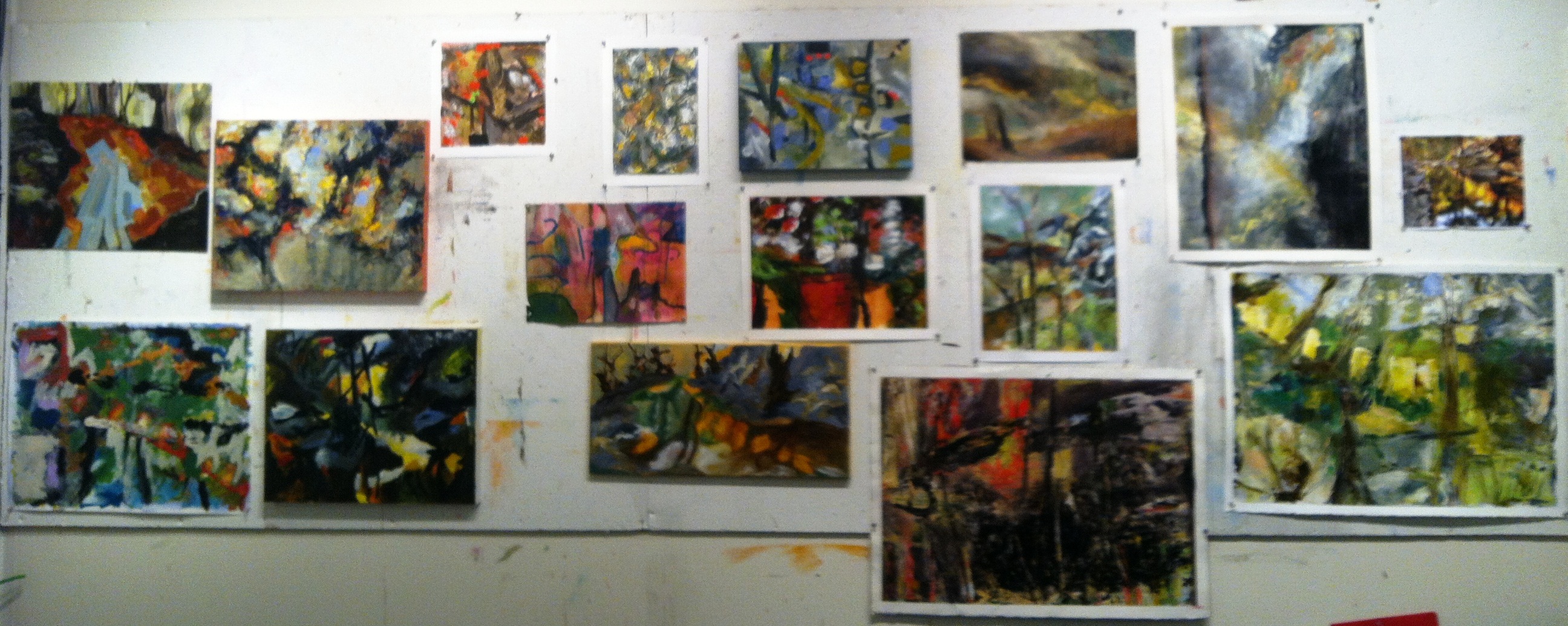
Obviously this applies to painting too, as we have discussed many times. However, as can be witnessed below, effective expression can come about even though the choice of subject was imposed upon reluctant artists. (For those who were not in class, these paintings-still in progress– all originated from the small photocopy on the far right. There was an inordinate amount of whining about this image. Note to self: Ignore Whining.)

The connection to subject is the most important aspect of the painting process. But consider the idea that “connection” can come about without intent. Simply by being present, being open and letting go of control and being willing to experiment and discover the relevance of what is in front of you.

Contemporary art currently champions the cerebral. Concept comes first.  So as we circle the many aspects of painting, this week I am going to suggest a concept to interpret and explore–containment. This means that you choose a subject while considering how the word might be embodied in a two-dimensional visual form. And then go from there.  I’ll show some examples at the beginning of class.  Be imaginative, but be true.

wall.all from one image

Posted in Uncategorized | Leave a comment

Wrestling Aligators

Sometimes staying stuck in the quagmire for a while is the best way to reap the benefits of faith and perseverance in the painting process.  I repeatedly witness (and experience) how uncomfortable it is to feel trapped in a place of dissatisfaction and unknowing while brush and paint seem to have minds of their own or when the skill set is not up for the challenge.  While struggling with a painting, one wants immediate relief and resolution when the “right” next step seems too elusive.  Sometimes suggestions and feedback from others provide help.  But many times the better path is to stay struggling.  It may seem harsh when you’re being passed by while you are in distress, especially when others are being praised. There are times when a life-line is the best choice. But very often it’s good practice to wrestle with the unseen “alligator” buried in the mud, and not succumb to a rescue. Sometimes the best path is to make more mud and fight your way out of that.

Feeling discouraged is a familiar state for an artist.  There are countless anecdotes about countless painters and their doubt.  Cezanne, perhaps the most famous “doubter”, as the French Philosopher Maurice Merleau-Ponty begins his 1945 essay entitled Cezanne’s Doubt explains: “It took him one hundred working sessions for a still life, one hundred- fifty sittings for a portrait.”  And still, at the age of 67, after years of acclaim and financial success as a painter, Cezanne, who is considered to be the father of modern art, writes of his “state of agitation and confusion” about his “slow progress”.  Then he says in a letter to a friend: “Now it seems I am better and that I see more clearly the direction my studies are taking.” He died a month later.

That flickering between doubt and understanding is what someone once described to me as “like the filament in a light bulb”—it’s what makes illumination.

This week we will do a “follow the leader” exercise we’ve done before.  The origin is an exercise in which each person wrote down the steps to follow for a partner to begin a painting.  We worked in pairs and as there was an odd number in the class, I paired with Janet.  Her instructions were deceptively simple, but very challenging. Like on Cezanne’s journey, they required I look very, very carefully at my image and see in new ways. And perhaps like Cezanne, it worked best trying to see from more than one perspective at the same time.  I repeat—her instructions sounded too simple, but were actually very hard. I struggled. So we’re going to use them to guide us.  There was a small Saturday class that will have a second chance at the exercise. It will be fresh for everyone else.

Have source material, or plan to search for some in the studio.  You can use either an underpainting or a clean substrate.  But an underpainting will require intense concentration.  Consider a thick wash over it.

A few quotes from Cezanne: “I am progressing very slowly, for nature reveals herself to me in very complex forms; and the progress needed is incessant.”

“One has to immerse oneself in one’s surroundings and intensely study nature or one’s subject to understand how to recreate it.”

“An art which isn’t based on feeling isn’t an art at all… feeling is the principle, the beginning and the end; craft, objective, technique – all these are in the middle.”

And finally—“ When a picture isn’t realized, you pitch it in the fire and start another one!”

Posted in Uncategorized | Leave a comment

Light Up the Sky

This last week I ran across two media interviews that served as a great reaffirmation for the new year of the value of art-making. The first is largely transcribed from the Charlie Rose show.  The second is a combination of transcription and paraphrasing, but fully capture what the writer was saying.

David Chase, creator of the Sopranos, on Charlie Rose: “Despite how it looks there is magic in the universe.  And it’s called art.   When we look at a painting and some kind of shiver goes down your back that is beyond thought, beyond emotion.  It’s something else—it’s almost spiritual. And if you’re lucky enough you can make some of that stuff, some of that magic— if you persevere you might be able to.

Charlie Rose: “It must be wonderful when an artist has something to say; when he hears someone say: ‘I felt like you were talking to me; or  that painting captured how I felt, or I saw something in your work that helped me understand life.”

WILLIAM DERESIEWICZ—Author of this NYT essay– http://www.nytimes.com/2012/10/28/opinion/sunday/how-food-replaced-art-as-high-culture.html?_r=0

On Q with Jian Ghomeshi when talking about the meaning of art and why culinary artistry is not “art”.  “Art means art and art also means craft.  If you’re Donald Trump there is the ‘art of the deal’, there’s the art of war, etc.  Craft means skilled—artisan food is creative, it is sensual. Food inspires feelings in us it  inspires memories.  But art goes beyond that.  There is a spiritual component to art—not religious. Not mystical, but spiritual.  It deals with things that go beyond the senses that go beyond what we can see and taste. Art has a way that explains our experience to us. It explains other people’s experience to us too.  By giving our emotions a certain kind of shape or pattern to create or represent some kind of meaning it elevates. It’s like the difference between gymnastics and ballet.  (sic) Gymnasts amaze. They are highly skilled.  But gymnastics is not designed to evoke emotion or give sense to our experience.

(The interviewer mentioned Duchamp’s urinal – Deresiewicz replies: “It surprises us.  It doesn’t tell us how to live but asks us to think about how we live.”)

Can a meal tell a story? I suppose.  My car can tell a story about me.  It’s old.  It contains artifacts that can give someone a clue to who I am.  But it is not transformative. (sic) It is not art and neither is food.

Art enlightens.”

Mr. Deresiewicz gave one of the best explanations I’ve heard of the difference between art and other creative endeavors.

I’m excited for another “enlightening” year.  Happy 2013!

Posted in Uncategorized | Leave a comment

Muddled

G-a-a-a-wd, I hate jet lag! For me east to west travel over multiple time zones renders my capacity to function productively to zilch. And it lasts for days and days and days. I tell you this as an apology for what I am about to pen, even though I don’t know what that is yet.

I‘ve thrown a dart at the internet and landed on the “benefits of travel” for which there are many writings. (At this moment, I question.) From mind-expanding new experiences, to redefining ourselves in relation to a different context, to a break from routine, it is widely thought that travel is good for us. And our desires to do so, to explore the unknown, to seek out the new and to see what we’ve imagined in real life have even religious connotations—think pilgrimage.

Reflecting on my recent holiday I’ve tried to pinpoint the most compelling parts of the journey. One of the things I like best is figuring out how to get from one new place to another and still allow for surprises along the way. Having a destination but only some idea of how to get there, exploring the things in between, changing the plan and then stopping to drink it all in and consider what might be best next is much of what makes up a travel day. It’s that process that is illuminating and satisfying for me. And oh, by the way, it’s much like the painting process.

Happy to know that a journey of discovery is as close as paper and paint. And even happier that it doesn’t involve jet lag. With hopes that the circadian rhythms sort themselves out soon, wishing you all a Happy New Year!

Posted in Uncategorized | Leave a comment

Look, A Moon!

HALF_MOON3_SEPHIA_10-18-07

IMAGINATION—1: the act or power of forming a mental image of something not present to the senses or never before wholly perceived in reality. 2: a: creative ability b: ability to confront and deal with a problem: resourcefulness. Merriam Webster

Remember what it felt like to lay in the cool grass with the sun on your face while staring into the cerulean blue sky? Remember the ease at which the fleecy clouds turned into a camel, a woman in a fur coat, or host of Looney Tune characters?  There was no pressure to see anything in particular, or at any specific speed.  It was leisurely and enchanting and time melted away. The painting process offers some of the same given time and openness.

Using the definition above as a guide, the first meaning is easy to understand. But part b of definition 2 “confront and deal” is something to think about in our context.  For the most effective and imaginative creating, you “confront and deal” almost at every turn–not just at the start.

We are such good “doers”. We’re prepared to solve problems or implement plans. And we’re eager to put a plan in place as fast as possible lest we feel lost or out of control. We struggle. We strive. But young children don’t strive. They play.  They watch. They discover.  They explore and unearth. They learn. And they imagine. (So do accomplished artists.)

My 2-and-a-half year old niece was eating her dinner while mom was filming her for out-of-town dad.  Mom’s prompting conversation: “What are you eating?”  “Ham.” “Do you like ham?”  “Unhuh.” “What are we going to do with daddy when he comes home….?” Etc….  In the meantime, Juliette is tearing her large, thin slice of ham into to manageable pieces when suddenly she says “LOOK, a moon!” With a third or fourth unpremeditated rip the round ham turned into the quintessential half-moon. For Juliette it was a moment of delight and wonder–poised to open new worlds.

Mom, however, had an agenda—to communicate with dad.  Although she acknowledged the moon, the opportunity to share the discovery and the road to which it might lead was traded in for the dialogue already started. Who knows where the conversation might have gone if moons had become the new topic of conversation….

We’re going to have time to work on the Xmas painting/underpainting exchange this week.  Since there may not be much left to be done, bring something else on which to work.  It’s a perfect time for me to paint on the wall and together we can see what lay in the marks, strokes and paint that’s waiting to be discovered…..

As Mr. Haywood says at Larson Elementary School in Some-town USA–“Wisdom Begins With Wonder”.

Posted in Uncategorized | Leave a comment

I Am A Broken Record (or perhaps the Walrus)

Painting:

Knowing; knowing everything; knowing how to make ‘this do that’ or ‘that do this’ is no substitute for passion and inspiration.  Nor is it usually the path to such.  It is the thing we hang on to for some assurance we’re doing it right when the tension of doing ‘it’ with belief and point of view—right or wrong– brings a vitality to the creative endeavor and to the result that is far more valuable than “right”.  The courage of conviction turns an act of discovery into a statement and, perhaps, into a unique vision.

Paraphrasing Len Goodman paraphrasing Leonard Bernstein:  When passion is too much for talk, sing; when it is too much for singing, dance.

All of our talking about color interaction and theory has had some eye-opening, some gee whizzes and some useful information, but the result is mostly still talk. It has little passion.  Color has the power to dance. But so many careful brushes yield so many dead brushstrokes.  We want dance!

In doing color research I ran across a video by someone of which whose name that, I am sorry to say, I did not take note.  He said he had been painting for 25 years when someone told him three things that were new wisdom for him: Preserve integrity of brush strokes.  Be authoritative.  Use more paint.

Recall the last time you put brush to page.  Did the brush strokes have integrity?  Were they authoritative? Did you use luscious amounts of paint? If not, what will it take for you to approach your work with enough passion to allow the colors to dance?  Will you continue being tentative until you understand color theory, or drawing, or composition, or any of it?

Jonathan Larson worked at Moondance Diner in New York for nine years while writing and composing theater musicals before finally quitting his job and committing to one of the musicals on which he’d been working–it was Rent.  During previews he died unexpectedly from an undiagnosed aortic aneurysm at the age of 35. He was posthumously awarded both the Pulitzer Prize and a Tony award for the show.

Don’t wait to be bold and loose with paint and brush.  Don’t wait for skills to develop (they will develop-be patient, but don’t wait.) Don’t wait for inspiration, go out and find it–look to the masters; to other artists, but make them your own; observe nature; listen to music; play with elements; notice what grabs your attention and breathe it in.  Kierkegaard wrote:  “Life must be lived forward but understood backwards.” Paint forward.  Understand it backwards.  Perhaps a broken record plays best that way too.

Posted in Uncategorized | Leave a comment